Reformational Commentary on Ezekiel 38:2
"Son of man, set thy face against Gog, the land of Magog, the chief prince of Meshech and Tubal, and prophesy against him." (Ezekiel 38:2)
"Son of man"
Throughout the book of Ezekiel, the Lord addresses the eponymous author as "son of man", a term otherwise only associated with Christ,
Who referred to Himself as such in the New Testament, but it was
also once applied to Christ in the Old Testament (in Daniel 7:13).
Though some have in response to that sought to reason that Ezekiel was in some fashion a type of Christ, there appears no compelling case for saying he
was so any more
than any other prophet given great disclosures of distant future events (e.g. Isaiah, Daniel, the Apostle John, etc.), and so the explanation for
Ezekiel being addressed thus probably lies in conveying the idea that he, though made the messenger of such a great volume
of prophecy, and in the case of the subject matter of Ezekiel 38, a prophecy of such near-future worldwide and long-lasting import, was a man of
low standing in society, neither a scholar nor a sophisticated artisan, but rather (as
John Gill suggests)
a simple agrarian, a lowly vessel
to whom God was pleased to deliver the promise of the most history-and-fortunes-altering events of the future church age
(from Ezekiel's perspective).
Hereby is a demonstration that the Lord will confound the wise and the mighty when it comes to choosing those upon whom He will bestow honour, for
there could have been few greater privileges in Old Testament times than being a genuine prophet of God, and even more so, one into whose care
such a momentous prophecy was delivered.
"...set thy face against..."
Ezekiel is ordered to set his face against Gog, who is the object of the Lord's contempt and one whom Ezekiel, and therefore all believers throughout
history, should show no pity, mercy or affection to, much less admiration; this ought to stand as a warning to modern conservative Christians who might be
tempted to hold this man in high esteem, a statement that should become more chilling when we come to assess who Gog might actually be.
Gog and the Land of Magog
Although three (Magog, Meshech and Tubal) of Japheth's six sons of Genesis 10:2 are mentioned in this verse, the country intended by Ezekiel 38:2 is
named after only one of the three, their older brother Magog, the inference being that his tribe constitutes the predominant nationality within the
land of Magog, and the other two are lesser, albeit still major, nationalities within the country referenced.
The first mention of the name Magog, along with Meshech and Tubal, is in Genesis 10:
"The sons of Japheth; Gomer, and Magog, and Madai, and Javan, and Tubal, and Meshech, and Tiras." (Genesis 10:2)
The identity of the man Gog, the "chief prince of Meshech and Tubal", synonymous with the land of Magog, was of some difficulty to
the old Reformed writers and accordingly they were not in agreement
on the matter, with some reckoning Gog to refer to a future Turkish ("Ottoman") leader and others surmising it might refer to a ruler of Russia.
We clear that up further below, but in the meantime, Gog is plainly presented here in Ezekiel 38:2 as leader of the descendants of the three of
Japheth's sons named, i.e., Magog, Tubal and Meshech, presented in federated association in the distant future from Ezekiel's day,
under the singular headship of Gog, and all resident in one cohesively singular country, the land of Magog.
Bear that in mind further below when we apply a timing methodology to identify the land of Magog, but in the meantime also
note that Gomer in Genesis 10:2 is mentioned in Ezekiel 38:6 as a separate powerful nation that is an ally of Magog, which we come to when
reviewing Ezekiel 38:6.
Returning to Ezekiel 38:2, Gill wrote:
...some render it,
"prince of Rosh, Meshech, and Tubal";
taking Rosh, as the rest, for the name of a place, a part of Scythia, from whence the Russians came, and had their name. So it is rendered by the Septuagint, Symmachus, and Theodotion; and some later Greek writers make mention of a country called Ros, which, they say, is a Scythian nation, situated between the Euxine Pontus [the Greek name for the Black Sea] and the whole maritime coast to the north of Taurus [i.e. the north eastern cost of modern day Turkey], a people fierce and wild.
Meshech and Tubal were the brethren of Magog, and sons of Japheth (Genesis 10:2), whose posterity inhabited those countries called after their name; who, according to Josephus are the Cappadocians [of what is eastern modern Turkey, but circa AD 70] and Iberians [not of what is modern day Spain (which bears the same name, Iberia), but of what is modern day Georgia]; and among the former is a place called Mazaca, which has some affinity with Meshech; and there was a country called Gogarene, a part of [Georgia’s] Iberia. According to Bochart, these are the Moschi and Tybarenes, people that dwell near the Euxine Sea, and under the dominion of the Turk [as of Gill’s era, in the 1700s] (John Gill on Ezekiel 38:2).
Gill, however, seeing no menacing forces in his day (the mid 1700s) greater than Romanism and Islam, was convinced that Gog would be a Turk and that Magog
was the land north of Palestine that is now modern day Turkey, a view which today is greatly promoted by those sympathetic to the eastern
apostasy that is Russian Orthodoxy.
But Gill was very wrong about this, as this commentary and near future world events shall show, for the Gog-Magog conflict is the opening battle
in the Armageddon war of Revelation 16:16 that comes under the final of the Seven Last Plagues and precipitates the
Jewish Epiphany of Romans 11:15 which, as predicted by the English Puritans, will come at or around the start of Daniel 7:18's "kingdom", one and the same
as the Philadelphian church age the Reformers and Puritans looked for.
(For an argument as to why the Philadelphian age lies still ahead, as of the time of
writing this commentary, see my article,
Why the Age of Missionaries was NOT the Philadelphian Church Era).
Today, the only powerful nation to the north of Palestine capable of leading an assault on Israel and unifying all the barbarian hordes
behind its headship is the same country that held much of the Islamic world as client states during the Cold War and the only country
to which the communist world looked for ultimate leadership for most of the Twentieth Century (something that the anticommunist authors,
such as
Jeff Nyquist
and
Trevor Loudon, convincingly argue remains the case).
That country, plainly, is Russia.
Therefore, my primary argument for Magog being identified as Russia is not so much in etymology, but in the timing of Gog’s move against
Israel, which must occur when (a) Israel as a nation has been restored to its historical homeland
(Ezekiel 38:8 - fulfilled since 14 May 1948, when Israel came into being as a
modern-era country), (b) is in a state of
unprecedented peace (according to
Ezekiel 38:11 and
Ezekiel 38:14 - so far, as of writing, unfulfilled, and (c) is
totally abandoned
by the West (Ezekiel 38:13), a process now underway with Britain, France,
Canada and Australia all
formally recognising a Palestinian state,
to Israel's dismay, at the United Nations in September 2025 - for more on this subject, see my article,
On Schedule: The West Begins to Forsake Israel.
Those indicators of timing, therefore, point to the Ezekiel 38 prophecy being fulfilled in the very near future and, that being the case, the
ringleader
nation at the head of the eastern bloc is readily identifiable as Russia, making it the prime candidate for being the land of Magog and its ruler,
at
least when it makes its move, as being none other than this persona of Ezekiel 38:2, Gog.
The Three Sons of Japheth in Ezekiel 38:2 Reconsidered
As mentioned above, the referencing of the three sons of Japheth in this verse is suggestive of Gog's country, "the land of Magog",
serving as the modern homeland of three distinctive major historical tribes, now united under a single government, and when we again consider Russia,
we observe exactly that.
This stands in contrast to Turkey, which has only
two significant ethnic groups, the Turks themselves who account for ca. 75% of the population,
and the Kurds who make up ca. 19%, none of the rest being substantial enough in number to stand out from the other small minorities as a distinctive "nation-within-the-nation".
- Major Group #1 is Magog: The Russians (ca. 77-82% of the population of Russia); with Gog himself etymologically tied to the name of the land of Magog, making him a member of that tribe, and presented as Magog's dominant persona and the object of this prophecy delivered by Ezekiel, and therefore obviously its ruler, though he also is described as "chief prince" of the other two tribes, which appear in subjugation to him (whether willingly or not); there can be no doubt that these points, combined with the timing argument, reveal the land of Magog to not just be Russia, the homeland of the tribe of Magog, but also to encompass the living spaces of Meshech and Tubal, and further reveal that Gog himself is indeed a Russian. The Jewish historian, Flavius Josephus, asserted in his Antiquities of the Jews that the man Magog was the father of the Scythians, an ancient nation centred on modern-day southern Russia and the western hinterland of the Caspian Sea, and be it noted that many Russian scholars have agreed that their tribe is descended from the Scythians, this having led to a movement within Russia in the 1800s called Скифство ("Skifstva") i.e., "Scythianism", in which Russian ethnic identity was tied up with the concept of the Scythians of old being proto-Russians.
- Major Group #2 is Meshech: The Turkic tribes of modern-day central Russia (ca. 6.7% of the population), such as the Tatars, Chuvash, et al. In Genesis 10 they are mentioned after Tubal, but in Ezekiel 38 they are listed before Tubal, and the reason for that, one might propose, is that today, as we stand close to the fulfilment of this prophecy, the generally "secular Islamic" and very widely distributed (see the map below) Turkic peoples in Russia have a slightly higher standing than the northern Caucasians (Tubal) do. Also note that there is a long history of genetic overlap between the Turkic tribes of central Asia and the far east-Asian tribes, and this I have observed at firsthand during several trips to Kyrgyzstan, where the majority population speaks a Turkic language, Kyrgyz, and is nominally Islamic, yet possess undeniable traces of east-Asiatic appearance. In the days of the Soviet Union, with the central Asian "stans" (e.g. Kazakhstan) also within the fold, so to speak, the Turkic proportion of the population was much larger, rather than on par with, the Caucasus tribes.1
- Major Group #3 is Tubal: The third large ethnic group in Russia is made up of the very insular and semi-autonomous northern Caucasian tribes that include the Chechens, Avars, et al, (also ca. 6.7% of the population of Russia, making them as numerous as the Turkics) and while their language is non-Turkic, they nonetheless practice the same evil heathen religion (Islam) as most of their Turkic neighbours within southern Russia, albeit with a radical tinge to it that the secular Tatars and Chuvash exhibit much less of; there might exist, therefore, an a priori argument that they, as a group of tribes, are corporately included within the Meshech group above. If that argument can stand, then the third "major" group referenced by Ezekiel 38:2 within modern Russia would be the Uralic-speaking peoples of Karelia, the Urals, and far eastern Russia (a very small percentage of the population of Russia), and the name Tubal, as pointing to the city of Tobolsk might, at first glance, be a veritable etymological breadcrumb pointing to that, since it is located east of the Urals and is regarded as the second oldest settlement in Siberia. Nevertheless, it is my view that the ethnic predominance argument trumps the corporate identity argument in a passage of Scripture that singles out specific heads of tribes (Meshech and Tubal) in an obvious callback to Genesis 10, and therefore I think Tubal almost certainly refers to the Chechens and their Caucasus-region cousins, making the Tobolsk connection with Tubal as tenuous, etymologically, as Meshech is to Moskva (Moscow). Indeed, Tobolsk is a better fit for Meshech's Tatars than for Tubal (whether as the Chechens or Finno-Uralics), given that Tatars are the largest non-Russian ethnicity in that city! This would make Tobolsk's euphonic association with Tubal an unfortunate red herring rather than an etymological clue.
An alternative (but incorrect) model would be that Meshech represents the Chechens and fellow present day north Caucasus-region tribes, while Tubal
would represent the Finno-Uralics of Siberia after all, leaving the Tatars and their fellow Turkic tribes presently resident in Russia excluded from
the list.
The reasoning here, without wishing to pre-empt the
commentary on Ezekiel 38:6, is that the Turkic tribes fall under the
head of Togarmah in that verse,
meaning they could not be descended from both Meshech and his nephew Togarmah, the son of Gomer according to Genesis 10:3.
The confusion comes from the native languages of those tribes; the central Asian Turkic tribes speak languages related to modern Turkish, but that does
not make them of the same tribe as the Turks of today, no more than Red Indians in modern America speaking English are of Anglo Saxon descent; rather, it is
reasonably well known that the Turks, as present day successor of the Ottomans, are notably distinct in ethnicity from the other Turkic peoples of
central Asia, and therefore not their genealogical close-match relatives; the
Turkic peoples are typically, though by no means superlatively,
defined as different ethnic groups unified by linguistic association.
That leaves intact the original proposal above for the identity of the three major groups within Russia, and renders the Finno-Uralics as outliers,
tiny in number, disparate in ethnicity and, within Russia at least, perhaps subsumable under the Magog head.
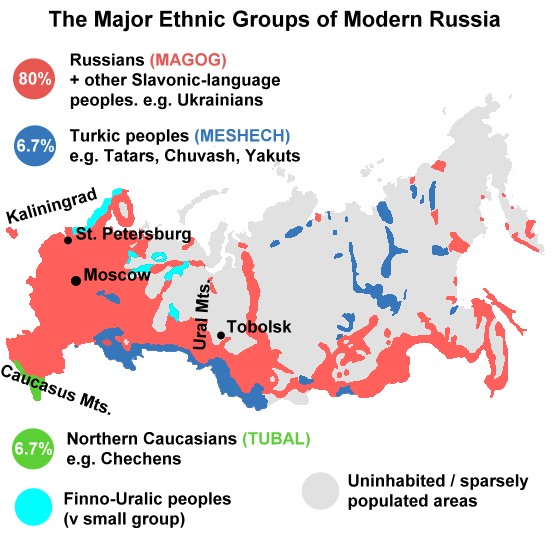
In support of the geopolitical timing arguments, rather than surpassing them as primary proofs, some have made much of etymological arguments for
Gog being the ruler of Russia at the time of the prophecy's fulfilment, suggesting that Meshech gave his name, through posterity, to what today is
Moscow (or Muscovy) and that Tubal likewise
is honoured in the name of the ancient Siberian city of Tobolsk.
And since Gog is “the chief prince of Meshech and Tubal” in Ezekiel 38:2, and leader of Russia when it will make that disastrous assault
on Israel, I submit that disputable etymological arguments confirm the much more robust circumstantial case that posits Russia unmistakably as the land of Magog.
Further Etymological Considerations PART 1: Rosh and Russia
As mentioned above in the excerpt from John Gill's commentary on this verse, it appears feasible to render the opening address to Gog thus:
"Son of man, set thy face against Gog, the land of Magog, prince of Rosh, Meshech, and Tubal, and prophesy against him."
That is, instead of "the chief prince of Meshech and Tubal" of the KJV
(or the reliable old Geneva Bible that came before the KJV),
it is "prince of Rosh, Meshech, and Tubal", which, given that Rosh is strikingly similar to "Ros" or "Rus", i.e.,
Kievan Rus (the historical name of the proto-Russian nation),
is certainly not an interpretation
that would find much favour with Russia's Orthodox members for the damning indictment plain etymology would bring upon that nation.
And yet we find the faithful Russian translation,
1876's Russian Synodal Bible,
using the prince-of-Rosh interpretation, with the operative word "Rosha" (from the root "Rosh")
highlighted in yellow:
"сын человеческий! обрати лице твое к Гогу в земле Магог, князю Роша, Мешеха и Фувала, и изреки на него пророчество" (Ezekiel 38:2)
Meanwhile, the faithful German version, the 1912 Luthertext, has it much as the KJV, going with "the chief prince" (highlighted in yellow below):
"Du Menschenkind, wende dich gegen Gog, der im Lande Magog ist und der oberste Fürst in Mesech und Thubal." (Ezekiel 38:2)
Likewise the faithful Dutch version, the Statenvertaling, renders it as "the chief prince":
"Mensenkind! zet uw aangezicht tegen Gog, het land van Magog, den hoofdvorst van Mesech en Tubal; en profeteer tegen hem," (Ezekiel 38:2)
So what are we to conclude is the intended meaning?
Was it worded to induce uncertainty, so that both possible understandings would be considered?
Yes, it was, and specifically to provoke serious study of the subject; there are no mistakes with God, so if He presented the wording to Ezekiel in that
fashion, it was so that we would be stirred up to look into the matter with appropriate diligence.
What is most fascinating, though, is that this deliberate ambiguity serves as a double witness to the identity of the Land of Magog, since both
"the chief prince of..." and "the prince of Rosh" point to Russia, and to Gog as its ruler at the time of the fulfilment of the prophecy, a time
we must be close to because the Jews have returned in large numbers to their historical homeland, the West is in the process of forsaking them
in readiness for the state of affairs outlined in Ezekiel 38:12, and the dynamics are in play
to bring about a very convincing peace deal in the near future.
Further Etymological Considerations PART 2: Meshech and Moscow
As alluded to above, some have seen in the name Meshech a resemblance to Moscow, Muscovy, Moskva, etc., the name of Russia's capital city and the
river that flows through it.
The etymology of this term is not settled, however it does appear to probably come from an old Slavic term for "wet", "swampy", "watery", etc.,
according to How Moscow got its Name.
That would render any euphonic resemblance between the patriarch Meshech and the city of Moscow purely coincidental; in any case, the resemblance is
not striking in the first instance and seems more of a stab-in-the-dark attempt at establishing a connection and should remain considered so until
archaeologists uncover evidence suggesting that the Turkic tribes of Russia played a critical role in naming the city, for it is they, as the second
largest ethnic grouping within the country, who are intended by the second-named son of Japheth, i.e., Meshech, in Ezekiel 38:2.
Further Etymological Considerations PART 3: Tubal and Tobolsk
Tubal has (as referenced above) been tentatively proposed as giving its name to Tobolsk in Siberia.
Like Moscow, Tobolsk is named after a river, in this case Siberia's
Tobol river, even though the city was founded by Russian Cossacks in the 1500s.
That river, in turn derives its name from a Turkic term, "low land" or "swamp" (rather redolent of Moscow's own naming), rather than being chosen
in honour of Tubal of old who, to reiterate, was the father of the third major nationality within the land of Magog, which today consists of the Chechens
and their ethnic brothers in the northern Caucasus region, far removed from Siberia.
Indeed, of the three major ethnic groups within modern Russia, the Tubal group is the most geographically contained, not sharing any of the visible
wanderlust of the Magog and Meshech groups.
In any case, look again at the faithful Russian version of Ezekiel 38:2 and how it renders Tubal, highlighted in yellow below:
"сын человеческий! обрати лице твое к Гогу в земле Магог, князю Роша, Мешеха и Фувала, и изреки на него пророчество" (Ezekiel 38:2)
Tubal in the verse is transliteraed from the Russian as "Fuval" (technically, for grammatical reasons, "Fuval-a"), which perhaps definitively neutralises
the Tubal-Tobolsk etymological case!
Summary of how we Identify Magog, Meshech and Tubal
The three brothers named in Ezekiel 38:2 are each patriarchs of substantial nationalities of the present day that happen to be contained within one major country,
the land of Magog; immediately, that disqualifies Turkey from being that land, since it contains only two major nationalities, the Turks themselves (70-75%) and
the Kurds (ca. 19%).
The country named in this verse of Ezekiel 38, the land of Magog, must from what is revealed in the rest of that chapter be the leader of the nations of the East at
the present time (in the near approach to the passage's fulfilment), and while many superficialist observers would assume that China fits
that bill, it is not to the north of Israel ("out of the north parts" ~
Ezekiel 38:15) and, according to the defector literature, is second
to Russia both in terms of
influence over the barbarian nations of northern Eurasia and the Levant, and also in terms of devastating nuclear firepower, with Russia possessing an arsenal that
dwarfs China's and, according to some analysts, exceeds America's also.2
With Russia as the land of Magog, and the patriarch Magog himself as their national father, his younger brothers Meshech and Tubal whose posterity reside
within Russia must be the two other large tribes or ethnic groups within the country, and those are respectively the Turkic peoples spread across Russia
and the less integrated, much more aggressive and inward-looking northern Caucasian peoples, i.e., in the former case the children of Meshech and in the
latter the children of Tubal, with the fact that the Turkics are more integrated making them more prominent and thus represented by the first-named of Magog's
lesser two brethren in Ezekiel 38:2, and the much more parochial Chechens, Avars, et al of the northern Caucasus being represented by the latter-named brother,
Tubal, in that verse.
All of the foregoing draws much more strongly on the contemporaneousness of the present demographic picture of Russia with the other circumstantial
conditions of the prophecy than on any etymological arguments.
Accordingly, one may assert a principle: etymological considerations are secondary to arguments based on contemporaneousness, and should be seen
as at best supportive of the latter (where possible), but nothing more, and this will become even clearer when we come to consider the identity of
Gomer in Ezekiel 38:6.
This principle I refer to as the Contemporaneousness Principle, and use it to cut through the fogs of etymology, tradition and linguistics in
identifying Gomer and Togarmah in Ezekiel 38:6.
A Final Genealogical Consideration: Magog and the Non-Russian Slavs
It has to be pointed out that many non-Russian Slavs, especially the Poles and Ukrainians, are very adamant in asserting that the Russians are not
true Slavs
and that the only Slavic thing about them is their language (in fact, some even try to argue that Russian is not a Slavic language at all, which,
as one who
lived in the Former Soviet Union for half a decade and was exposed to the language every day, I can say is an utterly absurd claim).
For these commentators, the Russians are of Finnic, Turkic or even
Sarmatian heritage.
But again, we have to appeal to the circumstantial-and-contemporaneousness arguments used above to identify Russia as Magog, and accordingly, Gog himself as
the leader of Russia when it finally makes the move foretold in Ezekiel 38.
So where does that leave the Slavs resident outside the land of Magog and who, in fear of it, are very hostile towards it?
The obvious answers are they are either:
- Disaffected breakaways from the main Slavic tribe (the Scythians / Kievan Rus), the main branch of which became the modern Russians and the rest becoming resentful neighbours and, at times, oppressed vassals.
- Ethnically of a different stock than the Russians, though linguistically related through the proto-Slavic language (see Balto-Slavic languages (itself a disputed term, as the Baltic languages of Lithuanian and Latvian are, according to many native speakers, not-Slavic at all!))
Going by physical appearance alone, something I have studied at length at very close range, I see remarkable physical similarities between the Poles,
Ukrainians and Russians, making them very distinct from the western Europeans; they tend to have in common with each other rounder heads, smaller molars,
blue eyes, blond hair, long limbs and a very slightly sallow skin colouration compared to Anglos, Scandinavians and other western / north-western
Europeans.
For me, therefore, the "real" Slavs of Poland and Ukraine are much closer genetically to the Russians than to any other major European people, and far
more so than the swarthy Bulgarians (also ostensible Slavs) of southern Europe, whose skin colour appears more Balkan / Greek.
Accordingly, it is my conviction that Magog himself, as Japheth's son, was the patriarch of all the fair-haired Slavic people, but that the main branch of
his posterity is made up of the Russians and it is they alone who are intended by the term Magog in Ezekiel 38:2.
But pre-eminently, I return to the circumstantial-and-contemporaneousness argument to identify Magog in this verse, as that cuts through all manner of
petty disputes about national origins.
Special Note on Revelation 20:8's Reference to "Gog and Magog"
Much confusion abounds amongst futurist interpreters (as it always does!) concerning the mention of Gog and Magog in Revelation 20:8, as follows:
" And shall go out to deceive the nations which are in the four quarters of the earth, Gog, and Magog, to gather them together to battle: the number of whom is as the sand of the sea." (Revelation 20:8)
This is not a prophecy of the Ezekiel 38 conflict but rather describes a far further future event that, for its enormity and the wicked design of those
prosecuting it, is named after the prototype Ezekiel 38-39 event.
What this is specifically has always been difficult to interpret, but I find myself in agreement with John Gill on this, who sees it as a vainglorious
attempt by the resurrected damned (under the terrible Second Resurrection) to unleash their murderous hatred on the immortal, resurrected elect who
were raised at the blessed First Resurrection.
FOOTNOTES
1. See:
Demographics of the Soviet Union.
2. This is despite US President Donald Trump's bombastic boast on 29 October 2025 about the US having the most warheads.
