Reformational Commentary on Ezekiel 38:6
"Gomer, and all his bands; the house of Togarmah of the north quarters, and all his bands: and many people with thee." (Ezekiel 38:6).
"And the sons of Gomer; Ashkenaz, and Riphath, and Togarmah." (Genesis 10:3).
The final two the nations participating in Russia's coming attack on Israel are listed here in Ezekiel 38:6 as:
- Gomer
- "the house of Togarmah of the north quarters"
1. Gomer
The mysterious Gomer who, like the three brothers named in Ezekiel 38:2 (Magog, Meshech and Tubal) was also a son of Japheth in Genesis 10:2, but here it seems odd that Gomer should be mentioned in contradistinction to his own son, Togarmah, unless:
- It is to show the former name as a generic for a broader group of people and the latter as a specific sub-class of them that is of their father-tribe’s genetic stock, but substantially different from them to such a degree as to make them stand out as a separate grouping, in which case Gomer refers to several nations and Togarmah to just one nation.
- It is to show that "the house of Togarmah" is a more specific descriptor added as a suffix to Gomer to (a) ensure the reader understands that all of the participants in this attack on Israel are descended from the same generation of brethren, namely, Japheth's immediate sons and (b) that of Gomer's posterity, it is only the Togarmahites who are intended, i.e., the verse is saying "Gomer (and his bands), specifically, the house of Togarmah of the north quarters".
I take the second theory to be weak, as there are other sons of Japheth not referenced at all in this enterprise, namely, Madai, Javan and Tiras and so
there is no consistent reason why Togarmah needs to be presented as anchored to the immediate sons of Japheth via Gomer, and accordingly, if only the
Togarmahites are intended, then there would be no need to reference Gomer at all.
That therefore means that Gomer in this verse of Ezekiel refers to a group of nations descended from Gomer's sons, Ashkenaz and Riphath, and that
"the house of Togarmah" refers to a much more distinct, readily identifiable and singular nation.
It also means that Togarmah is ethnically close to, yet discernibly distinct from, that group of Gomerite nations descended from Ashkenaz and Riphath.
We return to consider Togarmah further below, but first we ought to attempt to identify Ashkenaz and Riphath.
Ashkenaz has long been considered by the Jews to be the father of today's Germans, hence they speak of German Jews as "Ashkenazi Jews",
(whose dialect of German was historically Yiddish) and indeed, that term and association has been very widely received without challenge,
presumably because "the Jews should know", and for that reason a casual Google search of Ashkenaz will tell you that Germany is its modern
form.
The chronology, as established in Middle Ages rabbinical literature, is that the children of Ashkenaz were first annexed to, or part of, the Scythians
(the forerunners of the modern Russians and, probably, the Slavs in general - see my notes on Russians and other Slavs in the commentary on Ezekiel 38:2),
then to the Germanic tribes from the 11th-12th Centuries onwards.
However, not all the Jewish rabbis of that time agreed on this, with some instead seeing Ashkenaz as the father of the
Khazars, a veritably Turkic tribe which, by numerous accounts,
saw many of its members convert to Talmudic Judaism in the 10th Century.
In simplest terms, there was no consensus amongst Jewish scholars at the point at when Ashkenaz-as-Germany was presented as a theory, but regardless of
that, it became the prevailing view among Jews and, later among many non-Jews as
well1, and has led to Jewish traditions
invoking the name Ashkenaz
in their title - for more, see
this article on Ashkenazi Jewish traditions.
This is a classic case of theory transforming into fact through tradition, and you can see this is the
Jewish Encyclopaedia's article on Ashkenaz, which
simply ignores other historical (including rabbinical) understandings of the term.
Meanwhile, the
Armenians
have long considered themselves to be the descendents of Ashkenaz, a view still popular today among them, it being a common name given to their males
at birth, but again, it is based on tradition rather than irrefutable evidence; remember, all the modern nations began in the
sub-Caucasus area and so all of them have left traces of having resided or passed through that region, reminding us that the account of
Noah's posterity spreading out from the Ararat area is, in fact, like all of the Word of God, infallibly true.
So which of the above-named historical views is right?
The majority Jewish view that Ashkenaz is Germany?
The minority Jewish view that Ashkenaz is Khazaria?
The Armenian view that Ashkenaz is Armenia?
Or what if all three of them are wrong, and that Ashkenaz is none of the above?
To answer that, one would begin by reminding the reader that all three of the above views began as unsubstantiated notions that later became traditions and,
as is always the case where false religion is involved - and both the Jews and the Armenians have false religions - tradition crystallises into received
wisdom or "fact".
We therefore need a better way to identify Ashkenaz than the writings and traditions of false religionists or the dubious etymologies that see euphonic
similarity between "Gomer" and "Germania", and we come to that below, after we review Gomer's other son named in Genesis 10:3, i.e., Riphath.
Riphath has far fewer asserted interpretations, having vanished as a name for the most part in the writings of antiquity, although
there is a quasi-consensus that his descendants occupied, at least in-transit east, the western foothills of the Urals (presumably the southern Urals),
as mentioned by this article.
There is also a less popular theory that he was the father of the ancient Celts which, given their westward-wandering inclinations, would render the
Urals link extremely incompatible.
It is therefore apparent that there is neither etymological nor reliable traditional means for identifying the descendents of Riphath, who may have abode
until this day distinct from their brethren, the children of Ashkenaz, or who may instead have become subsumed by them, but in either case, it is
sufficient for both of them to be referenced collectively as Gomer.
So, having exhausted etymologies, spurious traditional views and fragmented records from antiquity, we have no recourse left in identifying Gomer other than
turning to the Contemporaneousness Principle first mentioned in the commentary on Ezekiel 38:2.
Using the Contemporaneousness Principle to Find Gomer
There is enough in Ezekiel 38:6 to enable us to identify Gomer's modern incarnation, and we do this through noting that Gomer (and Togarmah, for that matter),
as it arrives at its time-of-fulfilment form
2, is a powerful barbarian force
aligned militarily with Russia and therefore of the fold of the East, unlike Germany, which is distinctly, as it always was, of the West.
And this observation is what was alluded to by the phrasing, “Gomer, and all his bands”, i.e. “Gomer and his huge armies”
(and “the house of Togarmah of the north quarters, and all his bands”, i.e., “Togarmah, a nation northwards from Israel, with a very large military”).
The bands epithet is deliberate by the Lord to draw our attention to an important distinctive characteristic, because each of these nations
had to be given a name in the prophecy, and while their tribal identities would perhaps have been knowable to the
Hebrews of Ezekiel's day (ca. six centuries BC), it became lost over time, so another identifier suffixed to the name of Gomer (and Togarmah) was
needed to help us identify them as we approach the time of their gathering under the leadership of Gog.
And so I submit that Gomer is, via Ashkenaz and Riphath (Gomer’s other two sons named in Genesis 10:3), in fact none other than Russia's chief ally,
modern-day China, along with China's east Asian communist allies, especially North Korea (and perhaps even Vietnam), whose armed forces are also notably vast.
3
Togarmah
Togarmah, though one of Gomer’s sons according to Genesis 10:3, is named here as a separate end-times nation distinct from the other two elements of Gomer
reviewed above (Ashkenaz and Riphath), and like Gomer, Togarmah also is to be identifiable by his "bands" (huge armed forces).
This nation was understood by Gill to refer to some part of what is nowadays Turkey, or Tartary in the grassy
steppes of Russia and central Eurasia beyond, and cannot be simply the Turkic-speaking tribes as a whole, but more specifically, Turkey itself, the Turks
being ethnically distinct from the Turkic-speaking tribes of Eurasia.
This is because, as we have already seen, Tartary (i.e. where the Tatars abide) falls under the head of Meshech in
Ezekiel 38:2, subsumed within modern Russia, leaving "the house of Togarmah of the north quarters,
with his bands" as referring to a distinct linguistically Turkic nation located north of Israel with a large military.
Only one such nation exists, i.e., Turkey, which has the second
largest military in NATO (only the US military is numerically superior)4
However, there are two obvious problems with this theory:
- Turkey is currently aligned with the West as a member of NATO.
- The Turks are not east Asian like the Chinese and Koreans, so how can both China and Turkey (via Togarmah) be of Gomer’s posterity?
Objection #1: Turkey is a Western-Aligned NATO Country
In addressing the first objection, Turkey is increasingly a recalcitrant NATO member, busy in recent years flirting with Russia and angering the
rest of NATO.
For example, it
vetoed
and thereby considerably delayed Sweden's and Finland's accession to NATO (consequently serving a distinctly Russian interest) until
those two Nordic countries agreed to its demands concerning
"Kurdish terrorists" and Koran-burning within their borders and, before that,
it infuriated the US by procuring Russian military equipment5.
Turkey also sent warm
messages of support
to Vladimir Putin during
Yevgeny Prigozhin's abortive
Wagner Group Coup Attempt in 2023,
in the midst of
Russia's "special military operation" in Ukraine yet, paradoxically, formally supports Ukrainian territorial integrity; but this is almost certainly
just to placate its fellow NATO members, who very probably distrust
Turkey's offer to provide a peacekeeping role in Ukraine.
But there are also more solid evidences of Turkey's inclination or intention to pivot fully to the East, in the form of its
invitation in 2025 to become a
"partner country" with the Russian-led BRICS
(Brazil Russia India China South Africa) monetary system,
which is being developed initially as a counterweight to the US-controlled Petrodollar exchange system.
...Türkiye’s interest in engaging with BRICS+ reflects a broader recalibration of its foreign policy, seeking greater strategic autonomy amid the erosion of Western-centric global structures... (Dr. Serhat Süha Çubukçuoğlu, Senior Researcher / Director of Türkiye Office at TRENDS Research & Advisory, writing in Türkiye and BRICS+: Strategic Ambitions in a Shifting Global Order, August 2025).
The above quote is a very candid admission that Turkey sees the West weakening and is now fluttering its eyelids at the BRICS bloc.
But arguably more ominously, Turkey is now formally a "dialogue partner" of the
SCO
(Shanghai Co-operation Organisation), seen by some as a prototype anti-NATO, covering common military,
political and economic interests.
Obviously, therefore, as of 2026, Turkey's position might best be described as “on the fence”, or “running with the foxes, hunting
with the hounds”.
Like all Islamic nations, Turkey holds a longstanding animosity towards Israel that transcends the Sunni-Shi’a
dispute6, and would find itself
unavoidably tempted by any enterprise directed at overrunning and despoiling Palestine, especially if the West were deemed unlikely to intervene.
The foundations are therefore present, along with the military brute force and the recent precedence of arms supply arrangements with Russia, to poise
Turkey for a near-term switch to Moscow and out of the NATO fold entirely, formally or informally.
Objection #2: The Turks are not East Asian
This is a weak or even irrelevant objection for the obvious reason that other ethnically diverse tribes are descended from other Japhethite siblings;
the Indians from
Madai (via the Medes) and the Russians from Magog (probably via the Scythians), so there is no compelling reason why all the descendents of Gomer should
appear ethnically alike.
Nevertheless, some experts have invoked such things as linguistic similarities between the Turkish and Korean languages to support ethnic likeness,
but that is never a definitive confirmation of fraternity7.
Some have also sought to establish an origin of the Turks in what is modern-day China, but appear to conflate the speakers of the various Turkic languages
of central Asia with the modern Turks themselves; certainly, some members of the linguistically Turkic tribes of south-central Eurasia possess discernible
far eastern facial features,
as I observed first-hand during several visits to Kyrgyzstan, but as mentioned before when discussing Ezekiel 38:2, those tribes are descended primarily
from Meshech, not Gomer, and therefore are only Togarmahites linguistically, even though there must in their ethnic make-up be inevitable traces of
minimal or peripheral cross-breeding with both Togarmahites and the remaining Gomerites over the millennia, especially during eras of migration, but not to
the extent that their Meshechian essence is no longer the predominant one within their ethnicity.
That then leaves the Turks as retaining a cohesive core essence as a distinct family within Gomer, "the house of Togarmah" and more than that,
contained within a single nation, whereas the rest of Gomer seems to be spread across China, Korea, Japan, and the other far eastern nations.
And so it is this Togarmah "of the north quarters" (relative to Israel's location), that is modern Turkey, a nation of great self-estimation and
pride that, to outsiders in the West, looks ridiculous given its lack of geopolitical influence but which to the Turks is taken deadly seriously.
In the pecking order of the nations of the East, Turkey is incontestably behind Russia and China, despite its large military, which is dwarfed by theirs
and which lacks nuclear weapons, the ultimate coercive force that any nation can wield.
Turkey, therefore, is a follower, not a leader, among the eastern countries; it seeks to fall in line behind economic and military alliances
initiated by others, whilst proposing none of its own (because it lacks the economic power and geopolitical reach).
Turkey, for these reasons, can only play a tag-along role in the coming attack on Israel which Russia shall lead.
Current Relations Between Russia and its Allies Named in Ezekiel 38
To recap, Russia's allies listed in the coming assault on Israel are:
- China
- North Korea
- Iran
- Libya
- "Ethiopia" (Horn of Africa countries)
- Turkey
Russia's relationship with China is widely seen in the West as at best peer-to-peer, but perhaps more often as Russia assuming the
role of
junior partner due to the much greater size of China's economy and its far larger armed forces.
However, I agree with the anticommunist authors who assess the relationship as being converse to that, i.e., it is Russian-led, with Moscow
remaining as the
de facto world headquarters of Stalinist-Maoist communism, despite its fake transformation to a democracy in the early 1990s, and, before that, despite
the staged Sino-Soviet split from 1961-1989, exposed by the
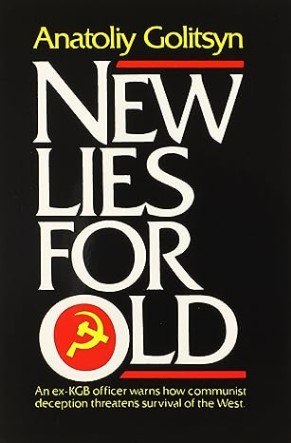
KGB defector Anatoliy Golitsyn in his 1984 book,
New Lies for Old,
as a charade to wrongfoot the West.
China, for all its economic power, enormous navy, army and air force, and for all its new advanced weapons systems (which more or less are in entirety
blatant plagiarisms of American designs), nonetheless lacks two things that Russia possesses, namely, technological inventiveness
(they can copy but can't innovate8) and
the unfathomable number of nuclear warheads and delivery systems that Russia has (despite China trying to play catch-up for years and years).
Russia therefore has the biggest stick, through its nuclear munitions, to be "last man standing" in any eastern showdown and has far greater experience in
waging asymmetrical warfare (i.e. subversion) against the West, including communist infiltration of institutions, than China has.
China's role is rather to support Russian nuclear assaults when the planned World War Three arrives, with an overwhelming swarm of manpower and, it
increasingly appears, to draw out and divert the US in the Pacific so as to give Russia a free run in Europe, which Russia has long desired to bring
into its own sphere of influence at the expense of the
Atlanticism that is the central object of hatred in its
modern version of Eurasianism (i.e. neo-Eurasianism),
as articulated perhaps most notably
by Aleksandr Dugin, a "far-right"
(read "final phase Marxist")9
author and seen by many as Vladimir Putin's "muse".
Meanwhile, China’s economy, according to the dissident Chinese commentator Mr. D. Wang of
Lude Media, is presently being steered
away from supplying western consumer demands and towards a predatory reconstruction model in which it would capitalise on military
gains made by its alliance with Russia.
Commenting in a February 2024 interview with J.R. Nyquist, Wang made the following observation concerning
China’s ailing economic situation:
...the solution for Xi is to move human resources to build up the military complex to get benefits from the Russian war in Ukraine and other global hotspots. The critical point is that when there is a sudden decoupling of China from the United States, Xi has to put everything into the military industrial complex to replace the previous economic pattern. At the same time, when Xi’s economy falls into the military pattern this will push Xi toward war – toward a global conflict.
....The CCP wants to support Russia with weapons because this facilitates China’s transition from producing consumer goods to producing military goods. So, the CCP depends on the Ukraine War to maintain their economic system and, eventually, if the Russians take over Ukraine, China will take control of key economic assets in Ukraine to pay for this war. This model is being established, and this model is very familiar to Russia. So, they are going to aim at the next war [i.e. World War Three], and they are going to continue this process [of expanding and expropriating resources]. You have to understand, all these military operations have to be paid for with something. The side that Russia defeats is going to pay for that war. (D. Wang, in Interview with Lude and Tucker Carlson’s Interview with Putin, 9th February 2024).
The above disclosure from a Chinese dissident should serve to outline why China would follow Putin’s lead into the doomed assault against Israel
later this decade.
Then combine that new Chinese economic model with the catastrophe of a misfiring BRICS regime (which I am predicting based on my understanding
of Revelation 16's second plague) and the motivational ingredients are there for the barbarian attack on Israel,
that is, to reboot their devastated economies after BRICS miscarries; and for the Islamic
element accompanying them, there is the obvious additional motive arising from the longstanding Muslim wish to wipe Israel from the
face of the earth.
North Korea, though a client state of China by most accounts, was originally a pet project not of China but of Russia and
it seems untenable, given Russia's headship role in the communist nations of the East, that it would simply surrender control of such a useful
thorn-in-the-side asset to another powerful communist country, unless it has been done by delegation rather than abandonment,
or else to project the appearance that Russia is not North Korea's principal.
Like China, North Korea's outsized army has been training with Russia's forces in recent years and the country has contributed troops to the war in
Ukraine, establishing a contemporaneous precedent for Russian-led real world military operations involving the nations named in Ezekiel 38's opening
verses.
Iran has no major formal military alliance with Russia or China, but such arrangements have never been as important to those countries
as they are to the West; for them, irrational red tape is for the masses to suffer unto while, at geopolitical level, they appear to either
like to keep alliances informal or else well hidden from the world beyond, including their own native populations, and here I would cite once more
the bogus Sino-Soviet Split of the 1960s-1980s as an example of a strong and thoroughly committed alliance obscured, not just by the absence of formal
treaties, but behind a charade of veritable enmity.
One can observe traces of Russia's and Iran's mutual loyalty (which is based not on ideology but on common geopolitical interests) in the form of
Iran's supply of drones to Russia for the war in Ukraine and in Russia's strong hint in autumn 2025 that "someone" might supply Iran with nuclear
weapons if Israel and the US continue to assault its nuclear weapons programme.
Iran holds great influence over the Hezbollah militants in Lebanon and supplies them with weaponry, including missiles for barraging Israel from time to time,
but in turn, Moscow holds sway over Iran and suffers it to make no major plays on the world stage without Russia approval, making Iran to a
meaningful extent a client state of Russia's.
Somalia is one of those lawless anything-goes Islamic car-crash countries (as obvious from the vile behaviour of its many émigrés in
western nations) that
has been a traditional ally or tinpot proxy of Russia in Africa, starting in the early 1960s when Russia commenced diplomatic relations with it and
trained its ragtag armed forces, as well as supplying the country with loans and, despite a falling out between them during the
Ethio-Somali war of the
late 1970s, Russia and Somalia are again on the same "team barbarian" as the build-up to final confrontation with the West proceeds apace.
Sudan is another Horn of Africa client state of Russia, from whom it receives some 87% of its military equipment.
Russia also has (or is close to having) a
Red Sea naval base in Sudan,
has its Wagner mercenaries actively operating in the country, and has mineral mining agreements in place
with the authorities there.
Meanwhile Turkey, to recap, has been flirting with Russia and its allies through the BRICS and SCO structures, as well as buying military hardware
from Russia and sending messages of support to Putin when, for a moment, it looked like the Wagner coup might succeed.
Some might object by saying that such a proposed alliance would flounder on China’s mistreatment of its Uighur population who, like their
linguistically Turkic kinsmen beyond China, are Sunni Muslims.
However, as of early 2025, it has been reported that Beijing is seeking to frame a “Central Asian Policy”
designed to alleviate concerns from the various “-stans” of Central Asia about this very
issue10,
presumably to avoid difficulties in receiving hydrocarbon supplies via pipelines passing through those territories.
We must expect they shall succeed with this act of diplomacy and that it will smooth the way for their alliance with Turkey et al,
so look out for more news like the following:
We now are facing something we have never seen before! The Turks and the Iranians are coordinating and cooperating. The Iranian foreign minister shows up in Turkey and he was treated like the second coming, while Anthony Blinken was treated like the red headed step child. All of these states are more capable than they were 50 years ago. They are quite capable of coordinating their actions to destroy Israel. This is a very dangerous situation. (Colonel Douglas MacGregor on Twitter / X, 15th November 2023).
A Very Clear and Present Axis of the East
It cannot be disputed that the nations of the East are, economically and militarily, in league and are planning a terrible war with the West.
What also cannot be disputed is that the head among them is the nation with the greatest nuclear arsenal, i.e., Russia, even though its economy
is comparable to that of the distinctly unthreatening nation of Italy, showing that "might is right" as far as ungodly power projection and
influence goes.
And yes, China obviously has aspirations to eventually assume the role of top dog, but first Russia and it must band to take on and defeat the West.
That in turn means both must have as much access to hydrocarbons in advance of hostilities as possible, this issue being a key reason why Germany
floundered in World War Two, and so they must desire the West's ejection from the Middle East.
For that to happen, the West must be diverted away from the region, by whatever means, and the gaggle of angry, Israel-hating Islamic states in
the region have to be brought in as allies (or useful proxies) willing to make plays under direction from Russia's geostrategic planners.
In addition to underlining the well documented long history of mutual assistance between the communist bloc and the Islamic world, this geopolitical
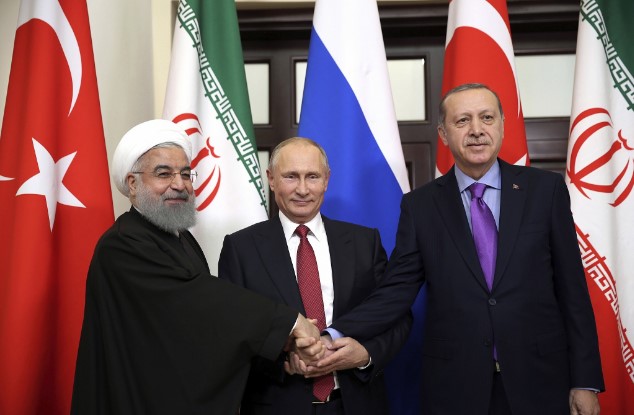
snapshot clearly presents Russia as assuming not just the leadership role, but also acting as “big protector” of the Islamic
component of the barbarian hordes of the East, as neatly summed up thus:
"Today, thanks to Russian President Vladimir Putin’s policy, Russia remains the most loyal ally and protector of Islam.” (Ramzan Kadyrov, head of the Chechen Republic within Russia and devoted ally of Vladimir Putin, speaking in May 2017).
But why no Egypt, Jordan or Saudi Arabia?
Naturally one might ask why Egypt, Jordan and Saudi Arabia are omitted from the list of nations following Russia in Ezekiel 38.
The answer, one might surmise, is that even though their people may perhaps be desirous of Israel's ruin, their rulers are still more
beholden to the West than to Russia (albeit western-armed and -equipped Saudi Arabia has shown an interest in joining BRICS), so it seems
likely they are cautiously inclined to adopt a wait-and-see approach.
However, I would not exclude the possibility of Kazakhstan, Kyrgyzstan, and one or more of the neighbouring "-stan" nations of central Asia, all
of whom fall as much under the head of Meshech as the Tatars, Chuvash, et al of Russia do (see the commentary on Ezekiel 38:2), but be it
noted that there are many petty disputes still raging among them.
A Reminder: Tradition and Etymology are Weak Interpretive Devices
I trust that by now the reader agrees with me that both tradition - even that which has become established as "fact" - as well as etymology, are
weak means of identifying the present-day successors of the tribes founded by the Noahic patriarchs, and that instead the Contemporaneousness Principle
(described above) is the most reliable way to solve these riddles.
All of the modern nations left traces in the Caucasus region and the lands around it because that is where humanity's diaspora originated when
Noah's Ark came to rest in Ararat, and so arguments derived from archaeological discoveries or the writings of antiquity, trying to fix Turkey as
the land of Magog are inadmissible because they lack conclusiveness.
Hence we defer to a better way: looking at the geopolitical conditions as we stand on the eve of the prophecy's fulfilment, and again, to remind
the reader, we know we are at that point because of the criteria listed in Footnote 2 below.
FOOTNOTES
1. Not a few commentators have attempted (foolishly)
to apply a weak etymological argument to connect the name Gomer with Germany / Germania / German, etc.
However, the Germans are ethnically as white and north-western European-looking as the Anglo Saxons, Scandinavians, Dutch, et al., in distinction from the
Slavs of eastern Europe (for example), meaning there is no possibility the Germans can be genetically far removed from the rest of us "Anglos".
I further propose that God has arranged it, with such esoteric nomenclature in Ezekiel 38:6 concerning Gomer, so that those with false eschatological models,
especially the futurism addicts (which I would assess perhaps
just less than 100% of professing evangelicals today are) will be shown to be in error and standing distinct from the tiny few who adhere to the
blessed Reformation's historicist interpretive model, so that when these events fall out, the latter will be honoured by God as having been right all along;
and be it noted that futurism is found where Arminianism abounds, both theologies being leaven inserted into Protestantism by Jesuit agents (and presumably others)
with a view to derailing the Reformation and preparing as much of professing Christianity as possible for a future reunion with "Mother Rome".
This highlights the fact that bad eschatology goes with bad soteriology, the former perhaps being a judgment from God, a strong delusion, for espousing
the latter.
2. We can discern the nearness of the time of fulfilment (as of 2026) from the state of fulfilment of the key prophecies concerning the circumstances of the Ezekiel 38 conflict, as follows:
- Israel, or a significant number of the Jews, had to be gathered out of the nations back to the historical homeland (Ezekiel 38:8), and this was fulfilled on 14 May 1948, when Israel came into being as a modern-era country.
- The Jewish homeland, after lying for centuries as barren, has to become transformed into a flourishing agricultural and developed country (Ezekiel 38:12).
- Israel must be forsaken, wholly or substantially, by the West (Ezekiel 38:13), a process now gathering pace with the wholesale orchestrated framing of the country for the Charlie Kirk assassination of September 2025 and the formal recognition of "a Palestinian state", by the UK, France, Canada and Australia (among numerous others) at the United Nations in September 2025, with the tacit support and approval of the US, despite its front-facing public condemnation of the move; the western governments, as Revelation 17 shows (in which they are styled as "ten horns", are all as one in terms of geopolitical policy and strategy, receiving their marching orders from the atheistic, globalist (crypto-Marxist) beast system that hides behind the charade of accountable democracy.
- Israel must be dwelling in a state of unprecedented peace (also Ezekiel 38:8 and Ezekiel 38:14); this is as yet unfulfilled, despite October 2025's risible peace treaty brokered by US President Donald Trump and his emissaries between Israel and Hamas concerning the ongoing Gaza conflict. Rather, what we should be looking for is a much grander peace deal in the Middle East, a spectacular one, perhaps one that sees Israel give up its nuclear weapons, and certainly one that is much more comprehensive than the Israel-Hamas deal that had foolish futurist interpreters in a tizzy, speculating that Trump or his son-in-law, Jared Kushner, is the Antichrist, seeing in that flimsy deal a fulfilment of Daniel 9:27's "covenant with many" not understanding or being aware of the historical fulfilment of that prophecy (because, being taken captive by the futurist delusion, they have no knowledge of or interest in Reformed eschatology). If there is to be a real peace deal brokered in the Middle East, it will perhaps be arranged by none other than the man Gog, the ruler of Russia, and in support of that one would refer the reader again to Ezekiel 38:14 where there is a possible hint or inference that he will be the peace-bringer, and in further support of which one could point out that only Russia, not America, has the influence, as unstated leader of the nations of the East (ahead of even China), to corral all the Islamic states behind a superlative peace deal in that region, and that it would do so through informal backchannel arrangements with them to backstab Israel at the opportune moment.
- Russia must, as leader of the East, not just have formal and informal alliances in place with China, North Korea, Iran, Libya, Somalia, et al, but it also should be in the process of gaining operational experience with its armed forces working hand-in-hand with those of its allies; so far, Russia has been performing many such exercises with China, and starting in late 2024, North Korean troops have been operating under Russian command in Ukraine, making this development another critical sign that the events of Ezekiel 38 are in the near future.
3. China’s active military personnel is currently numbered at around 2.2 million, with reserves and other forces bringing it up to 4 million.
North Korea’s figures are 1.3 million rising, with reserves, etc., to a staggering 7.8 million. Russia’s is currently under 1.2 million,
rising with reserves to 3.7 million. Iran’s is 600,000 rising to 1 million, Vietnam’s around 500,000 rising to 5.5 million. For more details,
see this
list of countries by size of military personnel.
4. According to the
Wikipedia's article on the Turkish Armed Forces,
“The Turkish Armed Forces is the second largest standing military force in NATO, after the U.S. Armed Forces, and the thirteenth in the world,
with an estimated strength of 775,000 military and paramilitary personnel in 2022.” Arguably, now that Finland has joined NATO, that Nordic country
can call even
more men to arms than Turkey can, but bear in mind that its regular army is small and that, unlike Turkey, most of its forces that it could
call upon are reserves drawn
from the civilian world. Certainly, it has a much smaller air force and navy than Turkey as well.
5. Turkey was removed from the F-35 Joint Strike Fighter procurement programme by the US as punishment for agreeing a $2.5 billion deal with Moscow
to purchase S-400 air defence systems
from Russia. Turkey remains under sanctions from the US for this acquisition, with pressure still being
exerted to force Turkey to abandon the project, but Recep Erdogan, Turkey’s bellicose president, defiantly
threatened to buy
fighter jets and submarines from Russia, which if he were to make good on his bluff, would more naturally align Turkey’s military with Russia’s
in terms of compatibility and supply of parts.
6. Most of Islam is Sunni (around 80%), including Turkey, Egypt, Libya and the Horn of Africa nations mentioned herein
(i.e. Ethiopia, Sudan, etc.), but Iran and Iraq are Shi’a. There has been a long history of mutual disdain between these two main branches of Islam,
typically and predictably spilling over into bloodshed. See
this article for details on the various branches of that
demonic religion.
7. Linguistic arguments are fragile, as should be apparent when (a) one considers, for example, that Americans speak English and yet are of
multiple ethnic origins and (b) there are many discernible commonalities between many languages despite the speakers being ethnically distant, for example, the Spanish
"no" and Russian's "nyet".
8. A case in point regarding China's innovation problem is its near total reliance on Russian-made jet engine technology for all
of its combat aircraft. These items are notoriously difficult to reverse-engineer and, so far, it appears China has had to accept it can only procure them
from Russia until such times as it cracks the technology itself.
9. Final-phase Marxism is called "fourth phase Marxism" in
this article, and
consists of
a final end to the division of labour in an total top-down management of assets, which means a tagged and tracked society whose spending choices,
whose
education, whose ability to travel, to receive healthcare, etc., are all entirely decided centrally by the state for the "greater good" of the hive,
so to speak. Such
a regime is already in existence in a prototype form with China's social credit system and Aleksandr Dugin (mentioned earlier herein),
like the crypto-Marxist elites who control the West,
advocates such a system for the rest of the world, but under Russian terms and Russian control. Accordingly, the coming global war (which arises out of
the
Ezekiel 38-39 conflict), is being driven by rival Marxist forces, albeit fairly successfully hidden behind the charade of democratic accountability
in the West
and the less convincing ostensible democracy of Putin's regime in Russia.
10. See this Caspian Report video (at around 8:30 minutes in):
11. As of 2022, Russia had 83 bases in Syria, some of which are concentrated close to the Israeli border; Turkey had 114,
almost all close to its own border with Syria;
and Iran had 131, distributed mostly along the western side of Syria, and densely in the south west region close to the Israeli border where it
seeks to strengthen and otherwise
support Hezbollah’s presence in that region "as part of its strategy to turn the region into a forward operating base against Israel"
(see this article).
Note that after the fall of
Bashar al-Assad’s regime in December 2024, Russia retained
its bases in Syria and is backed in doing so by Israel which mistakenly sees
Russia’s presence there as
a restraint on Turkey.
