Arminianism and the Star that Fell From Heaven
By J.W.M. Woods, July 2026
Contents
An Illustrious Visitation
The Jesuits React and a Parallel Protestantism Appears
The Counter-Reformation's Wrecking Ball
The Star That Fell From Heaven
Man's Will and A Crazy, Stupid Love
Can a True Believer Hold Arminian Doctrine?
The Prophesied Demise of Arminianism
The Protestant Weakness: Die and Let Live
An Illustrious Visitation
"And he that overcometh, and keepeth my works unto the end, to him will I give power over the nations: And he shall rule them with a rod of iron; as the vessels of a potter shall they be broken to shivers: even as I received of my Father. And I will give him the morning star." (Revelation 2:26-28)
When the Thyatira church age
came to an end and the Reformation began, marking the commencement of the present
Sardis era, the Lord's
faithful cause was gifted the "morning star", an illustrious visitation upon mankind by Christ Himself (Revelation 22:16),
but in such a manner as to be only a bright glimmer of a much more glorious day ahead, the "brightness of His coming" (2 Thessalonians 2:8), when the
Philadelphia age begins and
Lord's grand enemy on earth, the great imposter, that wicked one, the man of sin, that Antichrist that has sat in Rome since 366 (when a
Bishop of Rome first called himself Pope), will be consumed by the Spirit of Christ's mouth (the widespread preaching and acceptance of pure and
perfect doctrine) and the harlot Antichurch of Rome destroyed by fiat of the by-then-godly rulers of the western nations in accordance
with Revelation 17:16.
The Reformers, therefore, or else abstractly the Reformation itself,1
is chiefly what is meant here by the morning star promised to the Thyatira-era overcomers when that era would end, and it
will yet form a vital stepping stone for the coming temporal rulership of the nations by the godly once the real Philadelphian era gets underway (see
Why the Age of Missionaries was NOT the Philadelphian
Church Era), foretastes of which would have included John Calvin's authority in the Swiss canton of Geneva and perhaps aspects of Oliver Cromwell's
protectorate in England.
The Reformation was also to become poised as a deadly wound for one of the heads (i.e. forms of rulership) of the Beast from the Sea (Revelation 13:3),
that head
being the temporal-cum-ecclesiastical rulership exercised by the Papacy both directly over the Papal states and indirectly over the common people in
the many kingdoms of Europe, seen (a) by the turning of many Europeans, especially in northern Europe, to the Protestant cause and away from the Antichurch
of Rome (through a mixture of genuine conversions to Christ, speculative acceptance of Reformed doctrine and purely expedient alignment with Protestants) and
(b) by the wresting of kings, queens, princes and nobility out of the Romish ecclesiastical sphere of influence, probably almost all of whom were drawn
to the Reformed faith for speculative or expedient reasons, and not as true converts.
"The Reformation was a return to primitive non-apostate Christianity" (as
Henry Grattan Guinness
put it in
Romanism and the Reformation),
and
therefore stood as a shocking, clear and present danger to the Antichurch and a great vexation to Satan, which inevitably meant it was
going to be attacked and somehow slowed down, contained, derailed, polluted and ultimately (so Rome hoped), defeated, so that the deadly wound
it was inflicting on the Papacy's temporal and ecclesiastical power could heal.
The Jesuits React and a Parallel Protestantism Appears
Many today who call themselves Protestant may find it distasteful to know that throughout the first century of the Reformation (i.e. most of the 1500s),
Protestantism was essentially Calvinism and Calvinism was essentially Protestantism, and it can be demonstrated that the core doctrines thereof were
subscribed to by the faithful few before the Reformation began, going back to the early church in an unbroken
line (this is covered in more detail in the section, The Star That Fell From Heaven.)
Then, as the 1500s drew to a close, some within the Reformed fold began expressing a novel soteriology that constituted the diametric
antithesis of Calvinism, that is to say, it was fundamentally Anti-Protestant, all the while appropriating to itself the name of
Protestantism.
Reformed Protestants (i.e. Calvinists) rejected and reproved them at first, but as the 1600s proceeded, the Calvinists then, bar a few alarmed outliers,
began to carelessly accept these "other Protestants" as fellow believers and consequently fellowshipped with them, then compromised with them
(as the Fullerites did in the 1800s), then evangelised
with them,
then embraced their non-regulative form of worship, then forsook the Reformed camp entirely
and finally (in some instances) went not just fully Arminian themselves, but began to flirt with the Antichurch of Rome through
the ecumenical
movement; a complete case in point would be the declension of the Church of England.
It ought to come as no surprise, therefore, to discover evidence that the immediate roots of this new Protestantism lay in Rome
itself, given that the new soteriology was apparently first articulated by the Spanish Jesuit
Luis de Molina, writing in 1588, and
later some elements
of it were
proposed by Dutch theologian Jacobus Arminius
(1560-1609 and from whom the term Arminianism was derived after his passing).
Arminius, said by some (e.g.
Augustus Toplady) to really have been surnamed Van Harmin,
was not a "consistent Arminian" by the standards of others but rather he introduced three key elements of modern Arminianism to
erstwhile-Calvinism-defining Protestantism:
- He denied unconditional election, which seems to have arisen out of his unwillingness to commit to the supralapsarianism of the Reformation (i.e. God's pre-creation decree of who would be saved and who would not), with election in Arminius' view finally articulated as "conditional" on saving faith, i.e., he held that all biblical references to election amount simply to God foreseeing who would be saved.
- He denied or watered down the limited atonement of Christ on the cross, making it expansive, i.e. provided for all of humanity as opposed to performed for the sins of the elect alone.
- He denied irresistible grace, instead proffering a "prevenient" grace present in all of mankind that enables man to savingly believe if he so wills to do; i.e., Arminius subscribed to Rome's doctrine of "free will" that was at the centre of Erasmus' disputes with Luther, and inculcated it as a component of man's coming to Christ for salvation, making Arminius and all who would subscribe to his teachings every bit as synergist as the old Antichurch was and still is (note that many articles on synergism will claim - falsely - that synergism was the default Christian view during the early centuries of the New Testament church age.)
Those three points were subsequently developed by the Dutch Remonstrants after Arminius' death and added to with another two to form the basis of what we Calvinists typically term consistent Arminianism, as follows:
- That man is not in so ruinous a state of sin as to be unable to savingly believe independent of God's working, thereby denying the Reformed doctrine of total depravity ("dead in trespasses and sins").
- That through sin, a reborn man can subsequently lose his salvation, again at odds with the Reformed teaching that a truly regenerate man, though abiding still very much sinful, imperfectly loves God (which the unregenerate man cannot) and is born of an incorruptible seed and can accordingly never lose his new nature.
The Dutch Remonstrant (i.e Arminian) position became known as
The Five Articles of Remonstrance,
(technically "The Five Points of Arminianism") designed to stand in distinction to the various Reformed doctrines
of sovereign grace that Luther, Calvin, Knox, the other Reformers and the English Puritans all subscribed to; in reaction, Calvinists
would eventually express their own soteriology as five counterpoints, which abide – somewhat pejoratively in Anti-Calvinist (i.e. Anti-Protestant)
circles – as
The Five Points of Calvinism.
Alarmingly, Arminius was accused by one of his rivals, the staunch Calvinist
Franciscus Gomarus, of siding with the Jesuits,
presumably due to
Gomarus' knowledge of the aforementioned Jesuit Luis de Molina's Counter-Reformational assault on the doctrines of sovereign grace, and one suspects
Gomarus may have been framing
his accusations against Arminius in such a fashion as to avoid directly accusing him of being a Jesuit himself, whilst privately suspecting he was.
In fact, so intense was Gomarus' feelings on the dispute with Arminius that he declared he "would not dare die holding Arminius' opinion,
nor to appear with it before God's judgment seat".2
Augustus Toplady, around two centuries later, showed no scruple in recounting all the evidences from the mid 1600s suggestive of Arminius being
a planted agent of Rome:
If the joint verdict of Arminius himself, and of his English proselyte Hoord [Toplady here refers to Samuel Hoard], will not turn the scale, let us add the testimony of a professed Jesuit, by way of making up full weight. When archbishop Laud's papers were examined, a letter was found among them, thus endorsed with that prelate's own hand: "March, 1628. A Jesuit's Letter, sent to the Rector at Bruxels, about the ensuing Parliament."
The design of this letter was to give the Superior of the Jesuits, then resident at Brussels, an account of the posture of civil and ecclesiastical affairs in England; an extract from it I shall here subjoin:
"Father Rector, let not the damp of astonishment seize upon your ardent and zealous soul, in apprehending the subjoin and unexpected calling of a Parliament. We have now many strings to our bow. We have planted that sovereign drug, Arminianism, which we hope will purge the Protestants from their heresy; and it flourisheth and bears fruit in due season. For the better prevention of the Puritans, the Arminians have already locked up the duke's (of Buckingham) ears; and we have those of our own religion, which stand continually at the duke's chamber, to see who goes in and out: we cannot be too circumspect and careful in this regard. I am at this time transported with joy, to see how happily all instruments and means, as well great as lesser, co-operate unto our purposes. But, to return unto the main fabric:—Our foundation is Arminianism. The Arminians and projectors, as it appears in the premises, affect mutation. This we second and enforce by probable arguments."
The "sovereign drug, Arminianism," which, said the Jesuit, "we (i. e. we Papists) have planted" in England, did indeed bid fair "to purge" our Protestant church effectually. How merrily Popery and Arminianism, at that time, danced hand in hand, may be learned from Tindal:
"The churches were adorned with paintings, images, altar-pieces, etc. and, instead of communion tables, altars were set up, and bowings to them and the sacramental elements enjoined. The predestinarian doctrines were forbid, not only to he preached, but to be printed; and the Arminian sense of the articles was encouraged and propagated."
The Jesuit, therefore, did not exult without cause. The "sovereign drug," so lately "planted", did indeed take deep root downward, and bring forth fruit upward, under the cherishing auspices of Charles and Laud.
Heylin [Toplady refers here to [Peter Heylyn, an Arminian and grand opposer of the English Puritans], too, acknowledges that the state of things was truly described by another Jesuit of that age, who wrote thus: "Protestantism waxeth weary of itself. The doctrine (by the Arminians, who then sat at the helm) is altered in many things, for which their progenitors forsook the church (of Rome): as limbus patrum [a false doctrine held by the Antichurch]; prayer for the dead; the possibility of keeping God's commandments; and the accounting of Calvinism to be heresy at least, if not treason."
The maintaining of these positions, by the court divines, was an "alteration" indeed; which the abandoned Heylin ascribes to "the ingenuity and moderation found in some professors of our religion."
If we sum up the evidence that has been given, we shall find its amount to be, that Arminianism came from the church of Rome, and leads back again to the pit from whence it was digged.
(Augustus Toplady in The Historic Proof of the Doctrinal Calvinism of the Church of England)
In the 1700s, John Wesley would articulate the same Anti-Protestant soteriology as Arminius did, albeit he claimed to do so unawares of Arminius'
position on the matter, testament either to Wesley's lack of scholarship or to his dishonesty, neither of which possibilities paint a positive picture
of Wesley as a theologian.
Today, Arminianism stands in contrast to the Calvinism of the Reformation as follows:
- It holds that man is not so ruinously evil in his natural, unconverted state, as to be incapable of any latently good work (specifically, choosing to become a believer). He is not totally depraved, in other words. This opposes the Reformers’ assertion that fallen man, though frequently outwardly decent, is entirely evil and never exercises any selfless love for God. Accordingly, the natural man cannot willingly embrace Christ as Lord and Saviour.3
- Arminianism holds that God’s election as described in Scripture is really just a foreseeing of who would become believers. The Reformers held that election really is what it is called, i.e., God choosing in eternity whom He would give to His Son to save in time. Conversely, God also elected the rest unto damnation.4
- Arminianism holds that God loves all of humanity and Christ died for the sins of everyone, or rather, that His atonement was a generic fount of redemption rather than a bearing of specific sins committed by each individual. The Reformers, however, held that God loves only His own elect and that Christ died for the sins of His own people alone. That being the case, it can be further argued that rather than providing a potentially universal fount of atonement that is simply confined to the elect alone, Christ instead must have died for the specific sins of His own people (on a sin-by-sin basis) and in support of this, one might reference, for example, the diverse sacrificial procedures (which did not atone but pointed to Christ’s atonement) for different kinds of sin in the Mosaic era, such as described in Leviticus 5 and 6, or one could point to the variance in the severity of the eternal punishments to be meted out on Judgment Day upon the damned.
- Arminianism holds that God tries to save as many as possible (when brought into contact with the Gospel - despite never questioning why God does not providentially bring the whole world into contact with it) but that man can refuse to accept it through the exercise of his "free will" (allegedly because God loves mankind and would therefore not violate his "free will" – I explain why this is an illogical definition of love further below under the heading, Man's Will and A Crazy, Stupid Love). Moreover, Arminianism holds that salvation is contingent on the sinner accepting (of his ostensible free will) the pleading entreaties of Christ, and that the rebirth accordingly is something God works in the sinner after the sinner has come to Jesus. Conversely, the Reformers’ view was that God saves whom He will through an irresistible drawing to Christ performed by a work of the Holy Spirit, and that man has no free will in the matter (nor, indeed, in any matter, for "the carnal mind is enmity against God" (Romans 8:7) and therefore the unregenerate man's will is always at odds with God5). This Reformed doctrine makes election unconditional on man’s compliance with the gospel, so to speak, and rather points at it being a sovereign choice of God alone. It also means that the rebirth precedes coming to Christ for salvation, since the natural man cannot perform any righteous deed, such as humbly and reverently approaching Christ for salvation. Conversion is thus a sovereign act of the Spirit, and assurance of salvation comes not from reliance on "getting saved" at a service or making a "sinner’s prayer", but on discerning within one’s own heart a work of grace6, namely, traces of clean, holy reverence and respect for God7, selfless love for God8, or even finding the thought of exercising such love to be lovely in and of itself, as John Bunyan pointed out.
- Arminianism holds that man can, through sin, lose his salvation and (in extremis) can, on the other hand, through carefulness become sinlessly perfect in this life. The Reformers, however, held that salvation being of an incorruptible seed can never be lost, though the saved man remains a sinner in need of constant, daily forgiveness (as highlighted in the Lord’s prayer9, for example). The believer will be chastened for his sin and will struggle with it, as Paul the Apostle did10, but will gradually be brought through affliction, as David was, to become holier in his conversation and life11. And above all, the believer will persist with the faith, right until the end.
Many who are fundamentally Arminian in items 1-4 will reject item 5 above; but when I refer to Arminians hereafter in this article,
I mean both 4- and 5-point Arminians, even though probably most of them are simply 4-pointers.
Now note the timing of Arminianism’s arrival on the scene: the late 1500s.
This was after the Reformation which, having begun at the start of that century, had taken hold in northern Europe to such a degree that Rome was
well and truly at its wits’ end trying to contain it.
Note also that it was a stormtrooper of the
Counter-Reformation, that is, a Jesuit, Luis de Molina (mentioned above), who was at the fore of promulgating the doctrinal basis for
Jacobus Arminius' novel doctrines, and so we have a timing correlation that is highly suggestive of causation, that is, there is circumstantial
evidence that Arminius was perhaps influenced by Molina, if not an actual crypto-Papist himself.
But regardless, and more plainly, Satan was behind the appearance in the late 1500s of Arminianism, and hypothetically from a Jesuitic perspective,
the fundamental reason for Arminianism's deployment against Protestantism was to undo the Reformation.
But such a task could not be openly undertaken in the name of Catholicism or with the obvious goal of recapturing souls for Rome, as that would be too
blatant.
No, the trick would be to present a fair-sounding, reasonable, appealing soteriology that could be, on the surface, backed up with key passages
of Scripture (e.g. John 3:16) and plausible references to salvation being by faith alone, to charitably thinking no evil of anyone,
to the need for man to come to Christ, and so on, without any of the toxicity of bowing to Romish idols, prayers to saints, relics, or
any of the other paraphernalia of Popery, which things could be conceded and put on hold until the core of the Reformation’s soteriology
could be replaced.
Arminians were thus able to sound like Protestants on many issues, especially in their hostility to Romanism (which hostility all
card-carrying Protestants of the 1600s and 1700s were expected to show, and which Arminius himself expressed, naturally).
And so on the surface Arminians could talk about salvation being by faith, not works.
They were free to say Christ is the author and finisher of the faith.
They could say hell is real and that we need to be saved from it.
They could say that the Bible is the sole source of authority and is inerrant.
They could say that redemption comes from the believer’s sins being laid on Christ and His righteousness
imputed12 to the believer in return.
They could even say, as Jesus did, that man must be born again, that he must repent, that he must turn from sin and love God.
And they could do all of those things without assenting to a single uniquely defining point of Reformed soteriology!
And, due to the same lack of discernment in assessing the walks of professors of faith that dogged the early church and the pre-Reformation
believers, genuinely Protestant Christians charitably accepted as brethren these heretics, passing off their false soteriology as a minor
issue of disagreement, given that "they love the Lord just as we do".
Arminianism thereby was able to enter the church’s "east gate" as a theological Trojan Horse.
By the time the 1700s came to a close, Arminianism was well established as another, or even the dominant, strain of Protestantism through the
efforts of several champions, the most notable of whom was John Wesley of the
Methodist movement,
bringing with it more and more subtle concessions to the Romish Antichurch
in the form of worship, which not long after the Reformation had already begun deviating from the
Regulative Principle (in which only
worship positively mandated in the Word could be construed as acceptable to God) to the permissiveness of the
Normative Principle (in
which anything not specifically prescribed by the Word is allowed in worship) that has 99% of congregations today in its
vice.13
The Church of England, though aspirationally Reformed, succumbed to this stealthy Romish raid; today it does not know what it actually is,
much less what it believes, having become transformed into some sort of wellness cult or social club that is, nonetheless, suspiciously
rather well disposed towards Rome.
Even Wesley’s Methodists have in no small part found themselves ecumenically drawn towards Rome, driving the more old school minority among
them to schism (e.g. the Independent Methodists), but still clinging on to their Arminianism.
In time, however, even where Rome was still identified as the Whore of Babylon (in the historical Reformation fashion), eschatology too
started to wander from the
historicist model of the Reformation and,
by the mid 1800s, was well and truly infused with
futurism (whose
origins appear substantially Jesuitic also14) that deflected attention away from the
Reformation’s discovery of the Papacy as the man of
sin and towards a future, secular super-politician Antichrist figure, an interpretation so very convenient to the reputation of the Papacy.
Meanwhile, some denominations partially embraced Arminianism oblivious to the inconsistency of doing so, as all its doctrines are inextricably
connected; this condemnation falls heavily on the Brethren sects (who more or less espouse most of Arminianism but who reject the fifth point)
and most modern fundamentalist evangelicals as well, many of whom evangelise in an Arminian manner but claim – implausibly or with weak comprehension
of their claim – to be Calvinist.
It is probably fair to say that out of all the Protestant denominations, only a tiny minority, perhaps less than one percent, are still
truly Reformed officially, with fewer again truly Reformed in practice, making the departure from that which Sardis "first received and
heard" (Revelation 3:3) back when it began with the Reformation a matter of great sorrow and cause for crying out unto God by the few in
Sardis15 who remain with their garments (of doctrine and practice) undefiled.
The Counter-Reformation's Wrecking Ball
It is now a little over 500 years since the Reformation began (taking Luther's nailing of his
95 theses in 1517 as the opening act), and today,
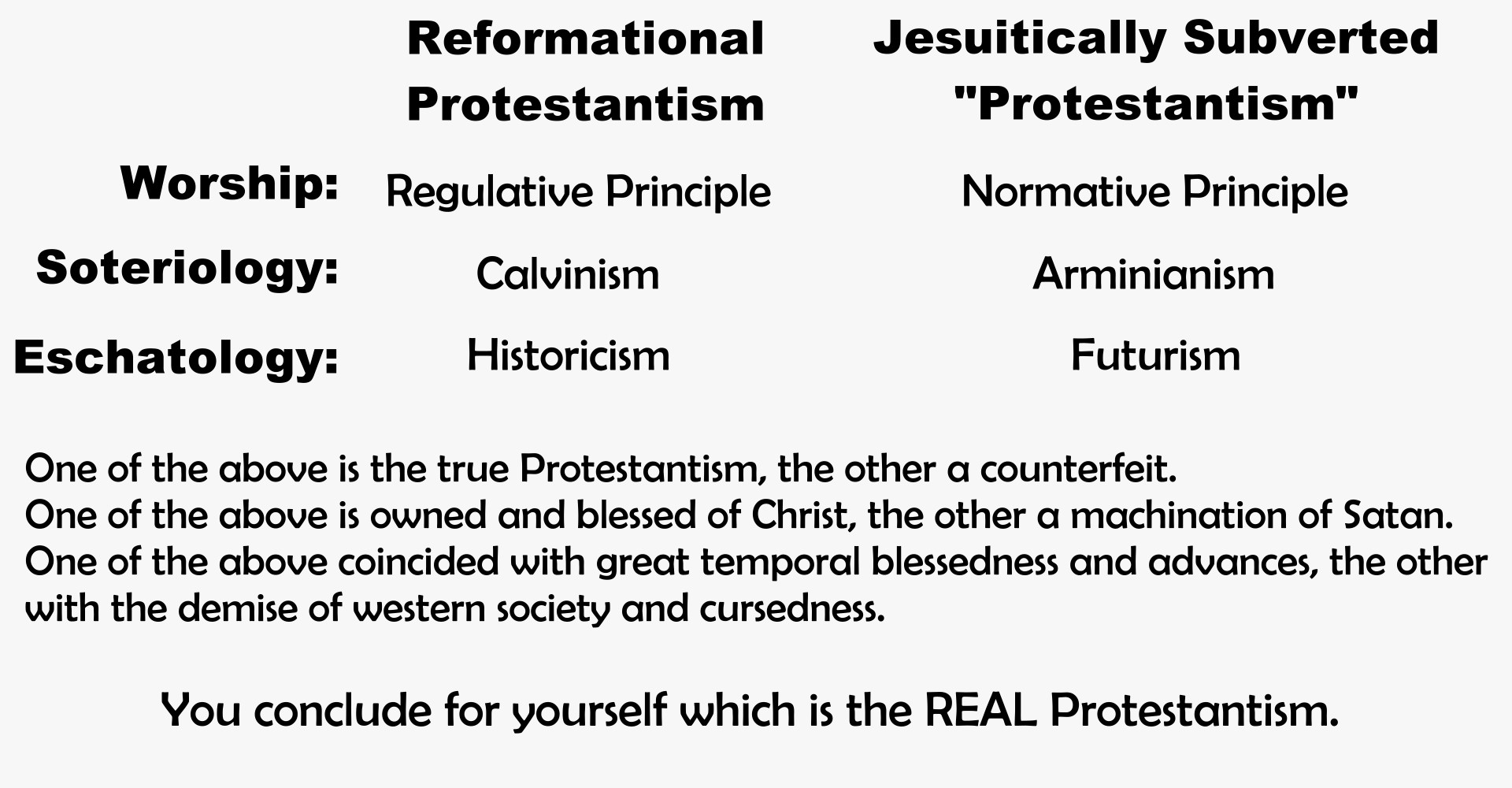
instead of seeing Reformational soteriology (Calvinism) and eschatology (historicism) as the immovable doctrinal pillars of a strong, all-conquering
Protestantism, we see a Counter-Reformational soteriology (Arminianism) and eschatology (futurism) in near total ascendancy, with the two
Reformational doctrinal pillars only found on the margins of observable Protestantism.
In other words, the doctrines of true Protestantism are exiled to the spiritual wilderness, along with the Woman of Revelation 12, the true church,
where she was to abide - despite the brief glimmer of light from the morning star that was the Reformers - for a full "time, times and half a time"
(Revelation 12:14), that is, for a period of one year of what the old writers called "prophetic time" plus another two such years, plus a further half
of such a year, amounting to 360 + (2 x 360) = 1,260 literal years, which for reasons explained in the footnote I take to run out around the end of the
present decade.16
This declension can be traced back to the sad fact that more and more Reformed believers from the 1600s onwards carelessly accepted Arminians as
"brethren with differences", demonstrating the very same failure to exercise discernment that plagued the Pergamos church age (Revelation 2:14-15)
and the failure to take a stronger stand against false teachers that characterised the Thyatira church age (Revelation 2:20).
The outcome of that carelessness is the indisputable fact that Arminianism has:
- almost killed the Reformation within nominal Protestantism, leaving it with a few "things which remain, that are ready (i.e. poised) to die" (Revelation 3:2) by usurping the Reformed soteriology (Calvinism) in all but a tiny handful of churches, and,
- facilitated the ecumenical movement by providing an un-Protestant soteriological foundation aligned with Rome's (i.e. a synergistic one) within erstwhile Protestantism, and thereby aided the healing of the deadly wound (Revelation 13:3) the quintessentially monergist Reformation had dealt to the Papacy.
From the above two observations, as well as from the anecdotes supplied by the old writers, Arminianism was deployed not simply to countervail the
Reformation, but to defeat it entirely; it has always been working against the cause of God and for the cause of Satan's Antichurch, those
observations together forming a testimony of a ruinously wrong Reformed attitude to Arminians.
The Reformed religion has clearly suffered from the same longstanding failure of the church transcendent to discern professions of faith
that had plagued it from Apostolic times and which had always left the door open for error to creep in, especially when borne by pastors that
are inwardly ravening wolves.
For example, had Christians in the Apostolic church age (i.e. the Ephesus era of Rev 2) been more circumspect in trying professions of faith, the early
round of heresies that brought on great afflictions for it in the ten years of
Smyrna's terrible suffering
would not have happened.
"...ye have brought into my sanctuary strangers, uncircumcised in heart, and uncircumcised in flesh, to be in my sanctuary, to pollute it, even my house, when ye offer my bread, the fat and the blood, and they have broken my covenant because of all your abominations." (Ezekiel 44:6-7)
Likewise, if believers in the Pergamos era that followed Smyrna had tested the professions of other professors of faith, especially their
pastors, then "Satan’s seat" would perhaps have not emerged in the form of the incipient Antichurch, and the office of the man of sin not
been able to ascend to the fore as the first "Papa",
Damasus I, in the year 366, later leading to the
Papacy assuming the title of
Universal Bishop with Boniface III in 606, still
within the Pergamos church era (for far greater detail on the church eras, see my article
Church History Foretold with the Seven Churches in Asia).
After that, if believers in the Thyatira church age that spanned from the mid 700s until the Reformation had been more discerning and more
steadfastly opposed to that self-declared "prophetess" Jezebel of Revelation 2:20 (the matured Antichurch) that they or many of them instead
seem to have tacitly accepted as an errant Christian church, then the Harlot might not have grown into the monster
that she did; remember, Christ was displeased with Pergamos and Thyatira for tolerating false brethren, regardless of
how "charitable" the true Christians of those eras thought they were being in doing so.
And so again, if Reformed believers in the present Sardis age had not been so ready to accept as believers anyone who could talk the talk and sound
fundamentally Protestant, Arminianism would not have gained entry and brought with it the judgment from God that is Protestantism’s
eschatological blindness that took root in the mid 1800s, when Jesuit futurism replaced Reformation historicism as the mainstream
eschatology within Protestant denominations.
Consequently, not only did Arminianism water down and damage Protestantism itself, it also served as a force of convergence between the Antichurch
and the body of Protestantism it infected, ether directly through ecumenicism or indirectly by creating conditions conducive to an atheism that is
now being proactively targeted by Rome for "de-secularisation".
A case in point would be the historically Calvinist nation of Holland, which experienced a spectacular falling away beginning more or less in the
late 1800s, when the Calvinist churches started to adopt liberal ideas from the
Enlightenment-influenced
University of Leiden (the same
university that gave us Arminius himself), as the graph below shows:
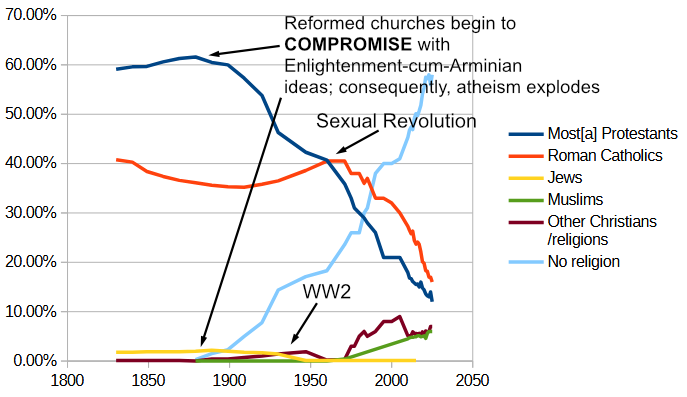
From the graph, we can clearly see that the horrifying surge in atheism was for decades almost exclusively and symmetrically at the expense of the so-called
Protestant churches, until the Antichurch's members got in on the act during the 1960s' collapse in public morality and decency known today as
the sexual revolution, a somewhat ironic
unintended consequence from the perspective of the orginal Romish propagators of Arminianism!
(We can also see that (a) prior to the late 1800s' compromise with Enlightenment liberalism, the Reformed churches were advancing at the expense
of the Antichurch and (b) later, just as the sexual revolution got underway, God began to send the
Muslim hordes, little-by-little, to Holland as judgment, along with other false religions.)
Note that some of the Enlightenment ideas, such as the freedom of man's will and agency at the expense of Calvinistic necessitarianism, were fundamentally
Arminian and consequently some have suggested that Arminianism either inspired the Enlightenment (both being late 17th century developments) or
facilitated its uptake simply by presenting the same core ideas, albeit Arminianism did so within an superficially Protestant context while the
Enlightenment did so on a purely humanistic level; either way, they share a common exaltation of man's free will and a denial
of predestination, and while the religious strand (Arminianism) aligns with the Antichurch's synergism (to prime for a future reunion with Rome),
the secular strand is considered to be the fertile soil from whence sprung modern liberalism, pluralism, tolerance, equality, etc., in sum, the
whole suite of communist doctrines at war with God, but as ever was the case with communism, presented in terms of liberty, fairness, decency, and so on.
Arminianism has thus largely undone Reformation Protestantism through both its direct soteriological impact on it and through the indirect motions of
liberal ideas originating in the Enlightenment, and thereby ensured that the Papacy, rather than succumbing to the "deadly wound" inflicted on that
unique form of ungodly governance (Revelation 13:3), instead recovered in the 1800s and regained much of the standing and influence it had lost.
"Judgment begins in the house of God" (1 Peter 4:17) and truly, the blame for the damage wrought by Arminianism falls squarely at the feet of the
Protestant pastors following on from the 1500s’ and 1600s’ bright start, who failed to consolidate the gains of the Reformation and did not press home
the advantages the momentum of the Reformation might have been expected to bring.
So, failure to assess professions of faith, wedded to failure to be as watchful and uncompromising in doctrine as Arminius' nemesis Gomarus
was, along with failure to be intolerant17 of false religion, have all combined to
bring Sardis to its knees.
The Star That Fell From Heaven
Arminians assert that the early church knew nothing of predestination and sovereign grace over man's will, and that these doctrines were only subscribed
to by mavericks like Augustine.
That would make the early church, with all its new converts and initial Gospel success, essentially Arminian by default.
However, this is demonstrably false.
Before the Apostle Paul, writing under inspiration from the Holy Ghost, articulated in Romans 8-9 explicit statements about God's
election, fore-love of some (i.e. Jacob), exclusion of others (i.e. Esau), and His divine purpose in the matter (i.e. being glorified in
showing mercy to some (Romans 9:23) and in showing His wrath against sin in others (Romans 9:22)), there were New Testament believers who had
come to Christ amidst the evangelising work of the other apostles and followers of Christ, apparently all of whom were ethnically Hebrew,
and who operated almost exclusively among the Jews, so much so that the very earliest Christians within the Roman empire were commonly known
simply as "Jews".
This original Israel-as-firstfruits point is important because it highlights the fact that the very first wave of Christians, being
Jewish, would have been well versed in the Old Testament scriptures, including those that made emphatic statements about the
sovereignty of God over the heart and the will of man.
Statements such as:
"O LORD, why hast thou made us to err from they ways, and hardened our heart from thy fear?" (Isaiah 63:17)
"Thy people shall be willing in the day of thy power" (Psalm 110:3)
"The king's heart is in the hand of the LORD, as the rivers of water: he turneth it whithersoever he will." (Proverbs 21:1)
"And give unto Solomon my son a perfect heart, to keep thy commandments, thy testimonies, and thy statutes." (1 Chronicles 29:19)
"Now in the first year of Cyrus king of Persia, that the word of the Lord by the mouth of Jeremiah might be fulfilled, the Lord stirred up the spirit of Cyrus king of Persia, that he made a proclamation throughout all his kingdom, and put it also in writing." (Ezra 1:1)
"...for the Lord had made them joyful, and turned the heart of the king of Assyria unto them, to strengthen their hands in the work of the house of God, the God of Israel." (Ezra 6:22)
"Blessed be the Lord God of our fathers, which hath put such a thing as this in the king's heart, to beautify the house of the Lord which is in Jerusalem." (Ezra 7:27)
"And I will give them an heart to know me, that I am the LORD: and they shall be my people, and I will be their God: for they shall return to me with their whole heart." (Jeremiah 24:7 ~ This refers to the house of Jacob's coming return to the Messianic fold.)
"And I will give them one heart, and one way [i.e. Jesus, Who alone is the way, the truth, and the life], that they may fear me for ever, for the good of them, and of their children after them." (Jeremiah 32:39 ~ This also refers to the Jews' coming return to the Messianic fold.)
"Turn thou us unto thee, O LORD, and we shall be turned" (Lamentations 6:21)
"...but I will harden his heart, that he shall not let the people go." (Exodus 4:21)
"And I will harden Pharaoh's heart" (Exodus 7:3)
"And the LORD hardened the heart of Pharaoh..." (Exodus 9:12)
"And I will turn thee back, and put hooks into thy jaws, and I will bring thee forth, and all thine army, horses and horsemen, all of them clothed with all sorts of armour, even a great company with bucklers and shields, all of them handling swords:" (Ezekiel 38:4)
"And thou shalt say, I will go up to the land of unwalled villages; I will go to them that are at rest, that dwell safely, all of them dwelling without walls, and having neither bars nor gates" (Ezekiel 38:11)
This is a view also asserted by Reformed writers of yesteryear; for example, Augustus Toplady wrote in defence of Anglicanism's original Reformed theology:
"The doctrinal system, established in England, which Luther and Calvin were the honoured instruments of retrieving, subsisted, from the beginning [here Toplady seemingly means the beginning of the New Testament church age], in the faith of God's elect people, and in the sacred scriptures." (Augustus Toplady in The Historic Proof of the Doctrinal Calvinism of the Church of England)
And so I submit that the very earliest New Testament believers, being Jewish, would have already been well versed in the fundamentals of
sovereign grace.
The Gentile converts that followed, however, would not have been familiar with those doctrines at all and so when Paul prioritised them as a core
element of his epistle to the Romans, (a) he did so as
"apostle to the Gentiles" (Acts 9:15, Ephesians 3:1), the elect among the world beyond the Jewish fold,
people who would not have been so familiar, if familiar at all, with the established Old Testament Scriptures, and (b) as an evangelist, he
saw fit to portray God just as He is (discriminating in His elective decrees) for the pure in heart (the truly saved) to
behold (Matthew 5:8),
rather than focussing exclusively on His mercy and the means of redemption, out of fear of offending or putting off the unconverted.
"Blessed are the pure in heart: for they shall see God." (Matthew 5:8); that is, they shall see God as far as He truly is revealed in Scripture, and then, in the next life, "face to face" (1 Corinthians 13:12).
I beieve we must therefore presume Paul was up-front with them, before they were born again, about the sovereignty of God, because that is part of the
whole counsel of God that he was stedfast in declaring to the Gentiles (Acts 20:27) and was accordingly precisely what unsaved, but elect, sinners have always needed to hear, no matter
how offensive to the natural man those doctrines are.
Undeniably then, the early church's evangelisation leaned heavily on the preaching of the essentially Calvinistic doctrines
of predestination, the non-universality of the love of God, and the bondage of the will of man!
And there is documented evidence to back that up in the form of the writings of
Irenaeus18 and
Clement of Alexandria.19
Therefore we can safely assume that the early church theologians, so far as they were true believers illuminated with the knowledge of Christ
in accordance with John 8:31-32, interpreted and understood passages such as Romans 8:29 largely the same way as the Reformers did:
"For whom he did foreknow, he did also predestinate to be conformed to the image of his Son" (Romans 8:2920)
" And when the Gentiles heard this, they were glad, and glorified the word of the Lord: and as many as were ordained to eternal life believed." (Acts 13:48)
And more than that, as Toplady and others have shown, the Woman (i.e. the true church transcendent) has always held those doctrines, even during the
Dark Ages (albeit not as well articulated as they were during the Reformation), because I too am certain that any disingenuous and earnest student of the Word
in the centuries following the completion of the canon of Scripture would inevitably come to Reformed soteriological conclusions if left at peace to
privately study the Word unswayed by the coercion of priests with a vested narrative; in fact, the further from formal, mainstream churching such
pure-hearted pre-Reformation private believers would have abode, the more clearly they would have seen God and, by inference, His plan of salvation
as they really are (Matthew 5:8).
And so these are doctrines that are neither exclusive to the Reformation-era believers (as Arminians would have us believe)
nor to the early Jewish Christians and the early Gentile converts.
Rather, these doctrines were synonymous with the Lord's faithful few (e.g. the Wycliffites
(Lollards) in England and the
Hussites of Bohemia)
when the light of the Gospel was exiled to quiet corners of Europe during the pinnacle of the Antichurch's raging pomp.
So much for the continuity of fundamentally Reformed articles of soteriology from the Apostolic era onward; what of the true vintage of the
opposing doctrines of Arminianism?
Before Arminianism appeared under its own name during the Romish Antichurch's Counter-Reformation, it had a prototype that struck the early church in the
Pergamos era.
That prototype was styled in Revelation 8 as Wormwood, a great burning star from heaven that would fall upon the rivers and fountains
of waters to make one third part of them bitter, causing many to die thereof:
"And the third angel sounded, and there fell a great star from heaven, burning as it were a lamp, and it fell upon the third part of the rivers, and upon the fountains of waters; And the name of the star is called Wormwood: and the third part of the waters became wormwood; and many men died of the waters, because they were made bitter." (Revelation 8:10-11)
"Therefore thus saith the Lord of hosts concerning the prophets; Behold, I will feed them with wormwood, and make them drink the water of gall: for from the prophets of Jerusalem is profaneness gone forth into all the land." (Jeremiah 23:15)
When the sea is not expressly mentioned in Revelation, but "waters", "rivers" and "fountains" are, the symbolism (unless exceptionally and
explicitly defined as peoples, as per Revelation 17:15) is to be interpreted as referring to matters relating directly or indirectly to doctrine,
scripture or religion, as is, for example, the case with the rivers and fountains in Revelation 16:4 (which refers to
the bloodshed found in false religion coming to a head in a final, near future and extremely murderous civil strife in the western lands caused by
the influx of Islamists).
This burning star of Revelation 8:10, this lamp that fell from heaven, refers to nothing less than a highly esteemed but unregenerate personage within the
professing church, that is, a pastor, or a theologian, one who brilliantly illuminated it from its "heaven" or "sky" or "elevated position",
but who succumbed to a great and terrible, soul-destroying error that precipitated both his own downfall and the contamination of the doctrinal
waters, so that all who imbibed or fully relied on his doctrine would "die", that is, lose their souls.
Gill initially proposes21 that this refers to the Pergamos-era British Celtic theologian,
Pelagius (or "Morgan", AD 390-418), who apparently
began with a good reputation as a veritable "star" of the church, but who in time became the father of Pelagianism, which denies the doctrine
of the total depravity of man, asserts that man can attain sinless perfection and that man has "free will" and thereby plays a part in his
own salvation22, in which regard Pelagius can be justly described as the father
of the modern doctrine of Arminianism:
"Pelagius, who was a man of great eminence in the church, of much learning, and made great pretensions to religion and holiness, and, like a star and lamp, shone forth awhile, with great lustre and splendour, but fell into very great errors; denying original sin, and asserting the purity of human nature, crying up the power of man's free will, and asserting that human nature, without the grace of God, was able to keep the whole law, even to perfection; and his name, according to his doctrine, was wormwood and gall, which embittered the sweet doctrines of the free grace of God, and affected the fountains and rivers, the sacred Scriptures, from whence these doctrines flow; so that instead of being pleasant and wholesome to men, through his false glosses and perverse interpretations of them, they became bitter and poisonous; and many souls, that received and imbibed his sense of them, died spiritually, and were lost and perished, as all must inevitably, who depend on the strength and works of nature, and deny and despise the grace of God" (John Gill on Revelation 8:10).
Pelagius was not quite the first to speak of free will; as an abstract concept, it had been proposed by Jewish rabbi
Ben Sirach around 200 BC, by no means a man of God, as well as being
author of the non-canonical book of Ecclesiasticus, also known as
The Book of Sirach.
There is no evidence, however, that Sirach's free will doctrine had any takers amidst the very early church; on the contrary, the fact that when
free will was eventually presented by Pelagius it stirred up so much controversy, suggests it was novel to professing Christians at the
time (around the start of the fifth century).23
And so Pelagius was the organic source of the doctrine of free will in the late-Roman era church, prompting the subsequently more Calvinistic
Augustine to vehemently refute Pelagius' novel teaching (while apparently but paradoxically and inappropriately still holding Pelagius in high esteem!)
Before disappearing from view,
Pelagianism and
Semi-Pelagianism (as complete theologies) endured
for several centuries in Britain and in some
other regions of Roman influence beyond the western empire, despite having been condemned at the
Council of Ephesus convened in AD 431 and at
other councils in the early AD 400s.
Nevertheless, Rome would eventually formally articulate the Pelagian doctrine of free will (while denying other elements of Pelagianism,
notably the teaching on original sin) in the
Catholic Catechism of 173124, but within visible
proto-Protestantism (much of which was still strewn with errors)
and later within Reformation Protestantism, the pernicious Pelagian doctrines lay largely extinct for around a thousand years.
It was only when the Reformation began taking root did Pelagianism make a comeback, in the form of the skilfully devised
counterfeit Protestantism that is Arminianism.
Pelagius, therefore, as the mystic identity of the man styled Wormwood is the only admissible interpretive fit of Revelation 8:10-11 because
of the timing of its arrival (i.e. during the Pergamos-era, when Satan sent a flood of errors after the
Woman25) and the fact that it
immediately and directly contaminated the doctrinal waters, and enduringly so, in the peripheral parts of the Roman Empire
(such as England at that time) and even more so than the Mariolatry that developed in time from the "God-Bearer" designation
assigned to Mary at the Council of Ephesus, since the works-based salvation heresy of Pelagianism extends beyond Romanism and
Orthodoxy right into much of nominal Protestantism today that still eschews praying to Mary.
This makes Pelagianism and its matured form, Arminianism, a downright superlative when it comes to perverting both early church and post-Reformational
soteriology, to the eternal ruination of many souls.
So where there has been a faithful remnant, there have been essentially Reformed doctrines of salvation; the same cannot be said of Arminianism, whose
doctrine of free will was unknown outside of the Antichurch of Rome for approximately one thousand unbroken years, during which time the Lord sustained
his true church on the hidden manna (Revelation 2:17) of the correct soteriology.
Within the early Antichurch, however, the Pelagian-Arminian doctrine of free will seems to have bedded in (as evident from the
Second Synod of Orange in 529 which endorsed synergism),
and thereby "the earth [the ungodly in the civilised European world] helped the Woman" (Revelation 2:16) by acting as
a sponge to soak up that and other heresies from the flood emerging from Satan's mouth as the western empire fell apart.
And that brings us to a second star that fell from heaven, that described in Revelation 9, as follows:
"And the fifth angel sounded, and I saw a star fall from heaven unto the earth: and to him was given the key of the bottomless pit. And he opened the bottomless pit; and there arose a smoke out of the pit, as the smoke of a great furnace; and the sun and the air were darkened by reason of the smoke of the pit." (Revelation 9:1-2)
This second star does not strike the doctrinal waters, but the earth itself, i.e., the ungodly in the so-called civilised world in the crumbling Roman
empire, and is sent as a judgment upon them.
By its timing, the second star appeared around the seventh century, and denotes another who had fallen from high esteem within the professing church,
namely, the bishopric of Rome which, having been apostatising for centuries and having called itself "Papa" (pope) since 366 when Damasus I
(as mentioned earlier in this article) was the first to disobey Christ in Matthew 23:9 by conferring that title on the office of bishop of Rome,
was now plumbing new depths of wickedness as related thus by Gill:
"the bishops of that city [i.e. Rome] had shone out in great light and purity of doctrine and practice formerly, but now about this time most sadly apostatised; they had been indeed gradually declining for some time, but now they may be said openly to fall from heaven, when Phocas, who murdered his master, the Emperor Mauritius [i.e. Maurice], and took the imperial crown to himself, gave to Pope Boniface the Third the title and power of universal bishop, about the year 606, which he and his successors exercised in a most haughty and tyrannical manner" (John Gill commenting on Revelation 9:1)
To Gill's notes I would add that conferring the title of universal bishop marked the beginning of the final maturation phase of the office of the "man of sin", that Antichrist of the Antichurch of Rome, who would not yet reach full apotheosis until the year 765, when the Thyatira church era opened.
This second star held the keys of the bottomless pit (as Revelation 9:1 reveals), not the keys of Heaven as he pretends, and he used them to open the
bottomless pit up so that thick smoke and vexatious locusts would emerge from it, the interpretation whereof is that the Papacy in its new
emboldenment as universal bishop provoked God into permitting Satan to unleash upon the western empire a murderous new creed that was ordained
specifically to afflict both apostate Christendom and Christ-hating Judaism, for which dual purpose the demon at its head was given its name in both
Greek (for apostate Christianity as Apollyon) and Hebrew (for the Jews as Abaddon), a name that translates as "the Destroyer".
That new religion was nothing less than Islam, the
vile, filthy, unnatural, anti-kindness, anti-mercy, antisocial, anti-compassion, demented creed of Satan, that appeared in the same century as Boniface III's
assumption of the title universal bishop.
There is therefore an organic connection between the emergence of free will in "Christianity" and the subsequent curses sent upon the ungodly in
the European realm, insofar as the Antichurch swallowed free will, hook, line and sinker and thereby forsook the monergism of the early church
(which, of course, they deny ever existed) for a
distinctly synergist view of salvation, but that in turn brought not just eternal death upon many (as Revelation 8:10 warned it would), but also
temporal judgment in the form of a surge in
the wickedness of the office of the bishop of Rome begun by Boniface III, which then in turn provoked God into sending the scourge of Islam first on
the western fork of the
Antichurch during the Saracen raids of the 700s and later, when the Ottomans irrupted into eastern Europe and besieged Constantinople in early March 1844,
on the eastern fork of the Antichurch (i.e. Orthodoxy), which endured abuse by Islamic overlords for 391 years and 15 days exactly (as foretold in Revelation 9:15),
until the Edict of Toleration
in late March 1844 brought that wave of judgment to an end.
Here we find the beginnings of a symbiosis between Islam and apostate Christianity; the Antichurch's very existence, especially its exaltation of its Pope,
provoked a Divine warrant for the deployment of Islam as a curse upon it, but in turn, the Antichurch has always sought to capitalise on the Islamic assault
by posturing as the vanguard of Christian European culture; this, incidentally, poses a new danger for professing Christians today in the West who are
alarmed at the current Islamic invasion underway, as exemplified by the efforts of Romanist apologists and ecumenicists in rallying disaffected white native
populations behind a vaguely defined "Christianity" and "Christian culture", both of which are strangely lacking in calls for national repentance but big on
exalting that rather nebulous construct they call tradition (with all the nuance that word has ever carried for Rome), all behind a
"new Crusader" banner.
And so, if we see a very near future counterfeit revival in Christianity that amounts to a last hurrah for the Antichurch, the centuries-old prediction made
by Thomas Goodwin in An Exposition of the Revelation will have come to pass.
And it will have been facilitated, aided and abetted by "the sovereign drug Arminianism", that grand destroyer of the Reformation.
Man's Will and A Crazy, Stupid Love
From a truly Protestant perspective, one of the grand facilitators for Arminianism is a superficialist, lazy approach to Bible study, with
an over-fixation on the New Testament at the expense of qualifying statements made in the Old Testament.
Perhaps nowhere is this more visible in Arminianism's declarations on God's love, which is described as universal in its reach yet resistible
by man's supposed free will.
This presents two immediate problems:
- If God loves everyone, then He is sending the objects of His deep love to Hell once they stand before Him. "I love you more than you can possibly comprehend, but because you did not give permission to me, the Almighty, to save you through my only begotten Son, despite all my best but ultimately vain efforts (not so Almighty after all then!) to persuade you, I have no choice, even though I have all power in heaven and on earth (Matthew 28:18), to cast you into everlasting fire. And because I am God, I foresaw all of this yet proceeded to create you, my beloved creature, knowing I would cast you into eternal torment, and so I made you to both love you and then cause you to suffer forever (whilst still loving you)... Surely the contradictions and logical fallacies of this Arminian-and-Romish position stick out like a sore thumb?
- If God would not violate our "free will" because doing so would be unloving, then we too are unloving when we override a stubborn toddler's refusal to stop playing on a dangerous road he has run onto; that is, if "free will" is so sacrosanct as to overrule it with decisive, affirmative action is to be unloving, then none of us should do anything more than try to reason with our children, young or old, when we see them on a course of self-destruction, especially given that the gulf between their wisdom / common sense and ours is much less than that between God's and ours. And yet God (in the Arminian-and-Romish depiction of Him) would not be so unloving as to disregard our "free will"... again I ask, what kind of crazy, stupid "love" is this??? Can any Arminian seriously, in all sobriety, explain how this is love?
But doesn't the Bible plainly state in John 3:16 that God loves the world?
Yes, but it also plainly states in Luke 2:1 that all the world was to be taxed by Caesar Augustus, yet we know the inhabitants of the Americas,
Australia, Scandinavia, etc., were not intended; rather, it was a form of speech used and well understood by the Jews of that time.
And another example of this treatment of the term world can be seen in Paul's statement about God reconciling sinners to Himself through Christ:
"...God was in Christ, reconciling the world unto himself, not imputing their trespasses unto them;" (2 Corinthians 5:19)
If Arminians want to say John 3:16 is a declaration of God's universal love for every human being who ever lived, then they must also agree that
Paul taught the universal salvation of every sinner through Jesus, regardless of repentance and coming to Christ; yet almost none of them makes
that argument at all.
But here we find that Arminians don't just understand love; they fail to understand forgiveness as well, because forgiveness and love are
inextricably connected.
That is, there is no true love for someone without concomitant forgiveness, and no true forgiveness without love, which we can observe
from the light of nature in our own dealings with those whom we love.
Yes, we can be displeased with things the people we love do, but we still love them regardless and have a principle of forgiveness working
within us towards them.
And so if God truly loves everyone, then He has truly forgiven everyone.
And if He has truly forgiven everyone, then everyone is going to Heaven and there is no such thing as a lost eternity or
the unforgivible sin that Jesus spoke of!!!
Meanwhile, returning to the love-will connection, if God is truly Almighty, His plan for any given sinner cannot be resisted:
"For who hath resisted his will?" (Romans 9:19)
"My counsel [including the election of sinners] shall stand, and I will do all my pleasure" (Isaiah 46:10)
Likewise, if Jesus is God indeed, then He cannot be a worker of vanity and therefore He cannot and would not do anything in vain, including dying for, and saving, sinners.
"...if righteousness come by the law, then Christ is dead in vain." (Galatians 2:21 - a repudiation of Christ dying in vain, which He would have done, not in respect of the elect, but of the damned had He borne their sins at the Cross.)
Rather, the Lord saves whom He will and leaves the rest to harden in their sin:
"Therefore hath he mercy on whom he will have mercy, and whom he will he hardeneth." (Romans 9:18)
"For it is God which worketh in you both to will and to do of his good pleasure" (Philippians 2:13)
And what is God's good pleasure for the elect sinner that God works in that sinner at conversion?
To both will to come to Christ for salvation, and to actually do so, both of which God works in us!
This is something that a natural man cannot conjure in himself of his own choice because he is dead in trespasses and sins, that is,
dead unto the least righteous act, with his will bound in chains to his sinful nature, for "the carnal mind is enmity against God" (Romans 8:7).
And this is notable too from the conversion of John the Baptist, in that his heart was regenerated as an infant in the womb, without
the normal means of grace that is "the foolishness of preaching"; he leapt for joy at the news of Jesus (Luke 1:41), despite not having even the
self-awareness or consciousness of a young child, much less the capacity to understand language; and yet there he was, unborn, with a new heart that
was demonstrably not at enmity against God and therefore not unregenerate (in fulfilment of the promise that he would be filled with the Holy Spirit from
the womb - Luke 1:15), all of which highlights the fact that regeneration is deeper-rooted
than the very consciousness itself; it is a transformation of a man's baseline nature to make him inclined to God, instilling in him a latent
love and reverence for God and righteousness.
Overruling that old nature therefore makes the Lord a total Saviour, making His people willing (by irresistibly bending their
innermost essence from whence the will flows) to come to Jesus, in a demonstration of His Almighty power (Psalm 110:3), so that all glory for the
salvation process belongs to God, with nothing reserved for the sinner, not even any imagined free will involved in the process!
God therefore grants repentance as a gift (see Acts 11:19 quote below), meaning we cannot of our own free will repent and believe; when God
commands us to do so, no ability is implied; rather, it is an abstracted decree, much like the decree to man and beast alike to be fruitful and multiply,
so that only those enabled by God so to do amidst the group these things are directed at may actually do so, and at a time of His choosing.
"And as I began to speak, the Holy Ghost fell on them, as on us at the beginning... When they heard these things, they held their peace, and glorified God, saying, Then hath God also to the Gentiles granted repentance unto life." (Acts 11:19)
Did you catch that?
Repentance is not of our own doing; rather, God grants it!
Moreover:
"Blessed is the man whom thou choosest, and causest to approach unto thee" (Psalm 65:4)
The Lord first chooses whom He will have come unto Him (as a believer) and then causes such chosen ones to do so.
"All that the Father giveth me shall come to me; and him that cometh to me I will in no wise cast out." (John 6:37)
That means that all who will never come to Christ for salvation are deliberately not gifted by the Father to
Jesus, so where is the Arminian-style equitability in that?
(Answer: Nowhere, because God is not equitable in whom He elects for salvation, but rather is absolutely discriminating.)
But more than that, the verse above also means that the gifting itself is causative
in the sinner's coming to Christ and must therefore precede it by eternal decree, not through foresight on the part of God.
Arminianism also portrays conversion itself as a certain result of "allowing the Almighty" (how absurd it is to assemble those three words thus!)
to save the sinner, leading many professing Christians to rely on a so-called "sinner's prayer" or an affirmative response to an altar call at a
service as proof that they are saved, rather than doing what the Lord's Word tells us to do with regard to establishing assurance:
"Examine yourselves to see whether ye be in the faith" (2 Corinthians 13:5)
That is, we are to look for a work of God in our own hearts, chiefly, selfless love for God, rather than drawing assurance from a work we
performed, i.e., "accepting Jesus into our heart", etc.
And so Arminianism perverts the definition of love, makes God a worker of vanity, makes a mockery out of God's election by redefining it as
foresight, and has sinners professing themselves to be saved without any internal evidence of a work of grace in the heart.
It is blasphemous too, because in addition to presenting a false picture of man's nature, it likewise misrepresents God's nature, bolstering
the power and agency of the former and diminishing the power and agency of the latter, and doing so under the lie that God loves all of
humanity unconditionally and with a longing redemptive intent.
Arminianism therefore, from a Satanic perspective (if not a Jesuitic one also), was skilfully crafted to subtly seduce erstwhile Reformational
Protestants little-by-little, inch-by-inch, into a works-based model of
salvation, with the eventual goal being to draw the Protestant denominations back into the fold of the old Antichurch of Rome, a mission which has been
almost totally completed, just as Thomas Goodwin warned would happen (writing in the 1600s).
Arminianism achieves this by leveraging free will as a mechanism to make man co-worker in his own salvation, but can't do so without presenting a
strange (yet largely unchallenged) defintion of God's love which, upon scrutiny, makes no sense at all!
And chillingly, Arminianism, with its definitions of God's love and man's free will, is undeniably ensconsed in the same camp as old Harlot Rome,
as the table below illustrates:
| Reformation Protestantism (Calvinism) | The New Protestantism (Arminianism) + Rome |
|---|---|
| Monergist, i.e., salvation is 100% of God (Psalm 3:8, Jonah 2:9, Revelation 7:10) and man contributes nothing to it. | Synergist, i.e., salvation is mostly of God but requires man's cooperation. |
| Man lacks free will and therefore God must make him willing to come to Christ (Psalm 65:4, Psalm 110:3, Philippians 2:13). | Man has free will and God merely appeals to that free will in the hope that man will respond positively; but, being God, He foresaw who would respond favourably. (This makes God appeal in vain to people He knows will not respond and therefore their Hell will be worse for not responding, but when coupled with the fact that God providentially does not bring all men into contact with the Gospel, begs the question why does God not simply ensure through providence that the Gospel will be presented only to those whom He knows will respond favourably to it?) |
| The transformation of man's sinful will into a will that comes to Christ is an expression of God's discriminating love. | Free will is explained (illogically, as already demonstrated herein) as an expression of God's universal love. |
| All glory for the sinner's salvation belongs to God. | The glory for the sinner's salvation must logically be shared between God and the sinner who "accepts Jesus". |
Can a True Believer Hold Arminian Doctrine?
From the very beginning, the Lord has always had His church, starting with Adam and Eve and continuing with the faithful few throughout the
Old Testament (all of whom looked forward to a coming Redeemer (Job 19:25)26 to justify
them before the Father - hence David says "Kiss the Son" in Psalm 2:12) and
continuing through the early church age, through the emergence of the Antichurch, onward through the declension of the Dark Ages, then the pre-Reformation
tremors of Wycliffe and Huss, and then the Reformation era, right up to the present day.
And I hope I have also shown in the section above, The Star That Fell From Heaven, that there have always been professing
believers - both pre- and post-Christ - who have adhered to
the Reformational understanding of predestination, election, the bondage of the unregenerate man's will to his dead-to-righteousness nature, and God's
sovereignty over the will of man, and so there can be no argument, on the basis of it being something novel to the Reformation, against the Reformed
soteriology (i.e. Calvinism) being a key belief of the truly saved.
And given that the doctrines of Wormwood bring on eternal death for a large mass of people, as Revelation 2:10 teaches, and that Reformed stalwarts of
the past (such as Franciscus Gomarus mentioned earlier herein) "would not dare die" holding those doctrines, and further, given that Arminianism's
uptake within ostensible Protestantism has all but killed the Reformation entirely and soteriologically aligned most of the erstwhile Reformed
denominations with the Antichurch of Rome, we must inquire whether an Arminian professor of faith can be saved at all.
Of course, most Arminians will agree with Calvinists that a sinner must be justified by Christ in a twofold manner:
- The sinner must have his sins punished in the atoning death of Christ, so that the sinner avoids eternal death;
- The sinner must have Christ's perfect life's righteousness imputed to him, so that the sinner is granted eternal life (this is denied by some Arminians, however, and is also denied by Rome.)
Arminians will further agree that "ye must be born again", i.e., given a new nature that loves God, rather than merely assenting to the facts of the
Gospel.27),
So far, we're on the same page.
But then we diverge on the chronology of the conversion process and other particulars attendant thereto.
The correct Reformational postion is that the rebirth, that new nature, is what causes a man to come to Christ for salvation, i.e., he must
already "fear" (respect) God and have love for Him when entreating Christ for salvation, otherwise he would be coming to Christ with a heart at enmity
with God (as the Legion of devils did when begging for mercy) and thus not be sincere in asking Jesus be Lord over him; we therefore make
the rebirth the focus of conversion and assign that rebirth wholly to the Spirit of God acting unilaterally within a monergist redemptive
framework.
As R.C. Sproul put it,
"...the faith that receives Christ for justification is itself the free gift of a sovereign God. The principle of soli fide [faith alone] is not rightly understood until it is seen as anchored in the broader principle of sola gratia [grace alone]. (The Pelagian Captivity of the Church by R.C. Sproul)
Conversely, Arminians say that the rebirth is a consequence of coming to Christ, and so they make the focus of conversion the coming to
Christ,
not the rebirth at all, in what amounts to a synergist (i.e. God-plus-man) depiction of conversion.
But what does it really matter, as long as some way along the line the sinner receives a new heart?
Well, it matters because the Arminian model places emphasis on the sinner to, independently of God, repent (despite Acts 11:19 making it plain that the sinner
can't do this without God working it in him) and believe the Gospel, as the entreaties
made by Arminian evangelists make plain.
And so the Arminian framework lays upon the unregenerate man that which is impossible for him to perform, being dead in trespasses and sins, and yet,
having been given the impression that he can perform it, lulls him into mistaking something less than the new birth - i.e., his coming to Christ -
for the basis of his assurance.
The Arminian model is thereby conducive to the sinner resting in his own works, something he himself did, i.e., saying "sorry" for his sins, coming
to Jesus, and so on, and therefore encourages the sinner to speak peace to his own soul on the basis of his own
testimony;28 and as an ex-Arminian myself, having been Sunday-schooled in the
Independent Methodist denomination, I can confirm this outcome in my own experience.
In contrast, the Calvinist model restrains the sinner from daring to rest easy on the matter of his salvation absent the realisation of a new heart
within himself of selfless love for God, even if it is very imperfectly and inconsistently seen; hence the emphasis on examining ourselves to see
whether we be in the faith (and also hence why Reformed believers often go through long periods lacking assurance, as witnessed by Thomas Goodwin
- and attested as a thing for our betterment - in
The Objects and Acts of Justifying Faith.29)
Arminianism therefore contains a dynamic that deters the awakened, but unregenerate, sinner from attending or paying heed to the means of grace
(sound Reformed preaching), because he is "already saved" (and besides, "Reformed doctrine is in error, don't you know?", they say in full ignorance
of the Jesuit fomentation of the "sound" Gospel of Arminianism!)
One might reasonably presume this is why Paul the apostle was all for preaching what he called "the whole counsel of God" (Acts 20:27), and
why he made a point of expounding predestination, election, etc., to the Gentiles in Romans 8-9; and if Paul saw fit so to do, then that's what
evangelism should consist of today as well, rather than a narrow focus on poorly explained (and poorly understood) definitions of repentance,
saving faith, and so on.
Hence if "it pleased God by the foolishness of preaching to save them that believe" (1 Corinthians 1:21), then it follows that He is
not going to honour false representations of His love, His grace, His work in salvation, man's will, and so on in evangelical preaching; at most, He will
only honour any preaching as far as it is correct.
One might object and point out that Arminianism says that the sinner cannot save himself; the reply to that is it contradicts that point by saying the
sinner must contribute something in the form of an affirmative free will decision for Jesus; this means that the redeemed sinner in the eternal
state would still be able to reserve to himself a degree of congratulation for making the right decision in his lifetime, thereby withholding some
revenue of glory from the Godhead; this point in turn, incidentally, this diminution of God's glory, stands as a powerful argument against the
false doctrine of free will!
The question therefore might arise, within the context of preaching Paul's "whole counsel of God": what is the minimal amount or "critical mass" of
sound teaching required in the God-wrought conversion process?
In answering I would ask you to consider this: just as the convicting work of the Spirit is an alarming arrest of the sinner before the Lord graciously imparts a new
heart of selfless love for Him, so the Reformed teaching (that the rebirth must first prepare the sinner to be received by Christ) may be used by
the Lord to hold them in a state of suspense and concern over their soul's eternal wellbeing; for some, this will endure fleetingly, for others
(such as was my case), it can last for years and can overlap the point at which the sinner actually becomes reborn, so that assurance on the basis
of discernible love for God is not automatically gifted upon conversion.
This panic at the realisation one cannot repent without God's enabling could be called part of the Spirit's "priming work", not that it can by
any means reform the sinner, but because God has deemed it necessary (bar when regeneration happens to an infant, as was the case with the unborn
Baptist John) to show the sinner, before redeeming him, the hopelessness of his situation in terms of his inability to keep the law, his guilt
before God, his need for a Saviour, and the sinner's inability to repent and savingly believe of himself without God's regenerative work!
Conversely, Arminian evangelisation, by fixating on the sinner receiving Christ (depicting Jesus as eager to save everyone) rather than on Christ graciously
receiving the repentant sinner, thereby inverts and effectively removes a critical link in the chain, so to speak,
or skips a critical step – the final hurdle, if you will - in God's prescribed model for mentally preparing the sinner during evangelisation;
after all, if the Lord sees fit to show us our hopelessness in keeping
the Law, so that we despair of that route to salvation, why wouldn't He also see fit to show us our hopelessness in repenting?
The Arminian model therefore results in an incomplete or fragmentary academic perception of the sinner's
desperate situation, conducive to an over-reliance on his own coming to Christ that is nothing less than a death slumber of the same sort
as Catholics are afflicted with; hence we can see why Revelation says of Wormwood, that "many men died of the waters, because they were made
bitter" (Revelation 8:11).
God reconciles the saved sinner to Himself... as He really is
"Therefore if any man be in Christ, he is a new creature: old things are passed away; behold, all things are become new. And all things are of God, who hath reconciled us to himself by Jesus Christ" (2 Corinthians 5:17-18)
Since a major element of conversion is reconciling the sinner to God, and since the pure in heart are blessed with seeing God (Matthew 5:8 -
i.e. as He truly is, namely, sovereign, discriminating, loving Jacob, hating Esau, etc.), and further, since a key part of that reconciliation
process is revealing how the sinner really is (depraved, unable to have faith without God's enabling, etc.),
it seems to me unlikely that God would reconcile sinners to a caricature of Himself, such as that portrayed by Arminianism, which stops
sinners from seeing God as He truly is, from comprehending His glory in election unto salvation and reprobation unto damnation, the immeasurable
mercy He shows in unilaterally saving the sinner, and so on.
(In pointing this out to a popular YouTuber who specialises in exposing false teachers, he asked me, "what is wrong with you?")
Arminian preaching, terrifyingly, has the sinner comforting himself with another God, another Jesus, and another Gospel, just as Paul describes:
"But I fear, lest by any means, as the serpent beguiled Eve through his subtilty, so your minds should be corrupted from the simplicity that is in Christ. For if he that cometh preacheth another Jesus, whom we have not preached, or if ye receive another spirit, which ye have not received, or another gospel, which ye have not accepted, ye might well bear with him." (2 Corinthians 11:3-4);
NOTE: Gill, I feel, misunderstands the sense of what Paul is saying here; Gill thinks Paul is saying that if a hypothetically even better Jesus, Spirit and Gospel could be presented then the Corinthians should accept it, but rather I take the sense to be that Paul is concerned that they might, if beguiled, very well bear with such new presentations and thereby bring ruin to their church.
And here we will find Arminians out, because they generally cannot bear the thought of God as He truly is; in fact,
Arminians appear to hate the Lord as He truly is,
and therefore we must wonder, can an Arminian be reconciled to God (i.e. saved, no longer having a carnal mind that is at enmity against Him) at all?
Hence it is very dangerous for Reformed Protestants to receive as a brother in Christ anyone professing Arminian doctrine, and this has been borne
out by the near total undoing of the Reformation by unwatchful Calvinists of the past carelessly treating Arminians as fellow believers, leaving
Protestantism today with only a few "things which remain" (Revelation 3:2).
A sinner's charter and anti-sanctification
Arminianism further presents God as very anxious to forgive us and save us out of overflowing love for all of mankind, including,
by implication, Judas Iscariot, Esau, Cain, Saul, the Amelekites and all the others named as condemned in the Word and currently in hell,
as well as the Antichrist and those who blaspheme the Spirit.
With God depicted principally as a loving figure (rather than also exercising wrathfulness toward unrepentant sinners), begging and pleading with us
to accept His love, to embrace His Son, with salvation presented as such an easy commodity to acquire, and with God ever eager to forgive, we in
turn find the doctrinal basis for what amounts to carte blanche to
"do what thou wilt"30 and,
unsurprisingly, there are people today who claim
to be saved but free to "sin like a devil" (i.e. to commit the deeds of the Nicolaitanes, which Christ hates and condemned Pergamos – the
church era in which both Popery and Arminianism (in its prototype form of Pelagianism) emerged) - for tolerating in Revelation 2:15); Arminianism's
mother, the Antichurch of Rome, is effectively infused with the same unspoken dynamic: sin at leisure, because God likes forgiving you!
That in turn stands against the work of God in sanctifying the saved sinner, in making him godlier through growth in grace and through chastening.
Another consequence of Arminianism is that, despite warnings of urgency from Arminian evangelists, it tends to cause the
sinner to think that Jesus, being ever eager to save him, means he can "get saved" at any time, such as on his deathbed, in which regard
Arminianism is even more of a sinner’s charter.
Further "tells" that indict Arminians
Since we know that the rebirth does not consist of the things that Christ has done in justification for the believer, but rather is a sovereign
act of
God, in which the Holy Ghost creates a new heart of selfless love and "fear" (i.e. a clean respect) for God in the sinner, it is impossible to assess
another man's profession of faith based on his statements of reliance on Christ alone, or even on his stated soteriology; rather, we can only discern it
through protracted observation of a man's works-and-words, for "by their works ye shall know them" (Matthew 7:16).
And so if a man says he relies on Christ alone for salvation yet persistently abhors and is hostile to the Reformed soteriology, we can assess him
as not reconciled to God as He truly is.
We further note:
"He is in the way of life that keepeth instruction" (Proverbs 10:17)
The inference is that those who refuse instruction in the sound doctrines of Reformed soteriology are what might be termed
unteachable and therefore ought not to be trusted as being yet in the way of life, rejecting and being repulsed by the true
nature of God, sin, the rebirth, etc.; and even those Arminians who are more receptive or open-minded to Reformed teaching should
nonetheless not be trusted as believers before they embrace the Reformed position as the stakes are too high for the cause of Christ should
it be found that they subsequently harden in their Arminian posture.
And, being unteachable, Arminians are void of understanding when it comes to key aspects of God's nature, sin, righteousness, the rebirth, etc.
"But he that received seed into the good ground is he that heareth the word, and understandeth it; which also beareth fruit, and bringeth forth, some an hundredfold, some sixty, some thirty." (Matthew 13:23)
"The righteousness of thy testimonies is everlasting: give me understanding, and I shall live." (Psalm 119:144)
Arminians lack the understanding referenced in the above verses and accordingly bring forth worthless fruit such as shallow
testimonies, fresh errors (such as Wesley's false doctrine of attainable sinless perfection), God-dishonouring innovations
in worship and subtle alignment with Rome.
Moreover,
"Then said Jesus to those Jews which believed on him, If ye continue in my word, then are ye my disciples indeed; And ye shall know the truth, and the truth shall make you free." (John 8:31-32)
If by "the truth" Jesus meant the truth in abstract, then by definition it encompasses knowing and accepting the gospel of sovereign grace
(i.e the Calvinist soteriology) and it includes knowing Him as He truly is, i.e., sovereign, elective, etc.; or if He simply meant
knowing Himself (Who is the way, the truth and the life), then, to repeat, it means knowing Him as He truly is, and so there is no getting
round the fact that an elect man will "know the truth" and therefore will be brought face-to-face with Calvinism and will sooner or later
accept it as true.
Hence professing Christians who abide hostile to the Reformation's Calvinism have openly failed to demonstrate knowledge of the truth that
Christ says marks out a disciple of His and they accordingly must not be fellowshipped with or trusted as being in "the way of life", even
though some of them may nevertheless be elect.
And so here I will reiterate a vital point:
Reformational Protestants (i.e. Calvinists) should not fellowship with Arminians and should not treat them as "brethren with differences".
Rather, we should hold the more open-minded Arminians at arm's length and reject the outrightly hostile among them as believers entirely, coming out
from among those deniers of the Reformation, being separate from them, being ready to have an answer for them, and
earnestly contending for the Reformed faith with boldness and absolute, immovable, and belligerent refusal to compromise with them, more or less
following the pattern set by Augustus Toplady in his dealings with John Wesley, or Franciscus Gomarus in his with Jacobus Arminius.
"Preach the word; be instant in season, out of season; reprove, rebuke, exhort with all long suffering and doctrine. For the time will come when they will not endure sound doctrine; but after their own lusts shall they heap to themselves teachers, having itching ears; And they shall turn away their ears from the truth, and shall be turned unto fables. But watch thou in all things" (2 Timothy 4:2-5)
Yes, professing Christian, and that includes you too, pastor... Be sound in your doctrine, be circumspect in choosing whom you fellowship with or whom you have preach to you31, and be watchful, especially knowing that we are still in Sardis, the very church age for which Christ has emphasised the need for watchfulness thus:
"Be watchful, and strengthen the things which remain, that are ready to die: for I have not found thy works perfect before God. Remember therefore how thou hast received and heard, and hold fast, and repent. If therefore thou shalt not watch, I will come on thee as a thief, and thou shalt not know what hour I will come upon thee." (Revelation 3:2-3)
"Behold, I come as a thief. Blessed is he that watcheth, and keepeth his garments [i.e. of doctrine that Paul marks out as so vital in 2 Timothy 4:2-5 and of practice (e.g. loving the brethren)], lest he walk naked, and they see his shame." (Revelation 16:15)
The Arminian inversion
There are obviously many people today who profess Christ yet are devoid of a Spirit-wrought work of grace in their hearts.
The Antichurch of Rome is full of them, as is its eastern fork in the Orthodoxy fold, but so are the so-called Protestant denominations that have
long been in bed with Rome as her paramours, either openly (like the Anglicans and other formal ecumenicals) or implicitly (like the fiery
fundamentalists who deny Sovereign Grace and push the Antigospel of Pelagius); and sure, there are elect people among the above, but they always
come out from among them, generally in unwitting response to the abstracted command in Revelation 18:4.
"...Come out of her, my people, that ye be not partakers of her sins, and that ye receive not of her plagues." (Revelation 18:4)
Crucial to fixing this problem is grasping that evangelicals operating within ostensibly Protestant churches, especially from the 1800s onwards,
have over-emphasised the New Testament's declarations of God's love, as observable from modern evangelical tracts and roadside placards, as
well as from its preaching, while ignoring both Testaments' explicit statements on His discriminating election of some unto eternal life and
the rest unto eternal death.
Reiterating a previous point herein, the sinner cannot evangelically believe in Christ absent a heart of belief first being
gifted to him (Acts 11:19) at God's choosing, and at a time appointed by God also.
So, contrary to Arminianism, which posits that the rebirth is granted by Christ in response to the sinner's coming to Him for salvation, the true
chronology is the inverse of that, i.e., it is that the sinner must first be reborn and thereby become willing in a demonstration of God's power
(Psalm 110:3) to come to Christ, i.e. caused by God to approach Him after first being chosen by God so to do (as Psalm 65:4 sets it out), with
the assurance that Christ will gladly receive such a reborn one and formally declare him saved.
And to make the sequence all the more explicit, Paul writes of God's election:
"So then it [i.e. election] is not of him that willeth [even though the will of the converted man is altered by God], nor of him that runneth, but of God that sheweth mercy." (Romans 9:16)
Election is therefore explicitly neither contingent on God foreseeing a sinner's independent "free will" affirmative response to the Gospel nor on the regenerate man's new will inclined toward loving God, but is purely and exclusively of God originating it in a pre-Creation demonstration of His mercy upon those whom He chose to love and therefore save according to a selection process we know nothing of.
Are all Calvinists Saved?
Naturally the cynical (i.e. Arminian) reader might presume or hope that I am arguing that all who hold to Calvinism are saved.
But Satan and the other devils also believe and tremble (James 2:19) and as Paul pointed out in 1 Corinthians 13:2, understanding all mysteries
and doctrine is of no profit if a man lacks the selfless love for God that is only possible in those who have been regenerated by the Holy Ghost.
And so, although ultimately only the Lord can know infallibly who is born again, the best signs from an assessor’s viewpoint
are professions of selfless love for God amidst a life marked by holiness of conversation, tender relief of the afflicted, concern for God’s
glory and honour, displays of filial love toward the brethren and a teachable spirit with respect to the gospel of sovereign grace, which
is absolutely the very kind of truth that a disciple of Jesus will know in John 8:31-32.
Be watchful, therefore, professing Christian, and remember what Sardis first received and heard: the Reformation, the very essence of which
was the Calvinist doctrines of salvation.
Otherwise you too will be
visited "like a thief" in Christ’s final scourging of the present Sardian professing church before the glorious Philadelphian age begins.
The Prophesied Demise of Arminianism
Despite its current prevalent position within ostensible Protestantism, where it has eclipsed and almost extirpated the Reformation's Calvinism
(hence the present Sardis church state is said by Christ to be "dead" (Revelation 3:1) and with a few things remaining that are "ready to die"
(Revelation 3:2)), Arminianism is nonetheless itself destined to be excised and destroyed from the face of the earth.
This is certain for the following reasons:
- The Old Testament prophecies of the Jews' mass conversion to Christ, which is to happen all at once (i.e. in a supernatural, abnormal
and Divinely coordinated manner that can only be explainable with Reformed doctrine), as alluded to in the following passages (for example):
- Isaiah 66:8
- Jeremiah 30:22-24
- Ezekiel 39:22
- Hosea 3:4-5
- Joel 3:16
- Amos 9:14-15
- Micah 7:18-20
- Zechariah 2:10-13
- The prophecies of unprecedented blessedness brought to the Gentile church when the Jews come in from the cold in Romans 11:12; because if the Gentile church is to become much "richer" (spiritually) than hitherto, then it must have much greater love for God and between the brethren, plus total unity in all its doctrines, with a pure and perfect soteriology and eschatology and no more divisions over baptism. And this much is referenced in Joel 3:18's happy aftermath to the last great war (i.e. Revelation 16's "great hail"), in which "the mountains shall drop down new wine [repeated in Amos 9:13's prophecy of the house of Jacob returning to Christ], and the hills shall flow with milk, and all the rivers of Judah shall flow with waters, and a fountain shall come forth out of the house of the LORD, and shall water the valley of Shittim", i.e., there shall be tremendous temporal and spiritual blessedness, the latter by definition incorporating perfect doctrine.
- The promised ruin of the Whore of Babylon, the Mother of Harlots, whose Jesuits (overt, covert and de facto), refurbished and reimagined Pelagianism in a new Trojan Horse form that became Arminianism for the express purpose of undoing the Reformation; and so if the Sardis-era root of Arminianism is to be destroyed in Philadelphia's opening period, so will the branches of Arminianism likewise perish, and with them their concomitant Jesuit eschatology of futurism that has so many silly professors of Christ today chasing prophetic shadows, hoping for an imminent return of Christ that will not, because it cannot, yet happen.
- That the religious unbelievers who survive the coming "great hail" (Revelation 16:21) that closes out the Sardis era and marks the opening of the Philadelphian shall be compelled to acknowledge the rectitude of the doctrinal position of the long-beleaguered and reviled faithful few in Sardis who have kept their doctrinal garments white; this is deducible from Revelation 3:9 in which "them of the synagogue of Satan (i.e. erstwhile Jews and apostate "Christians")" will come and "worship" at the feet of the Philadelphian faithful, i.e., to openly acknowledge either willingly or through gritted teeth that those vile Calvinists were right all along.
And perhaps all of the foregoing will be bundled up in the onlooking world's reaction to the conversion of the Jews during the terrible Gog-led
attack on Israel.
Because after all, what shall the Arminians conclude when they see that a whole nation has converted at once?
That they all of their own "free will", in the greatest coincidence in history, decided to savingly believe in Jesus?
Or that God coordinated, orchestrated and irresistibly effected it in accordance with His promise to no longer be wroth with the house of
Israel but instead to show mercy unto them for the sake His own great Name?
And then what shall the Arminians and all the other apostates say when the newly converted Jews profess a Reformational soteriology, i.e.,
that the doctrines of sovereign grace (aka Calvinism) are correct?
How will the Arminian camp reconcile that to an obvious act of God in spectacularly delivering Israel from its attackers and in converting
the survivors of that assault to become Calvinistic believers in Jesus at the same time?
This will prove the first major strike against Arminianism, with its death sentence to be completed when its secret mother, the one who
repackaged Pelagianism during the Counter-Reformation, i.e., the old Whore of Babylon, the Antichurch of Rome, is destroyed by the instrumentalities
outlined in Revelation 17:16, all under the final of the Seven Last Plagues.
What will be left when Philadelphia gets well underway will be not just a fountain, not just a stream, but a veritably unfathomable river of
doctrinal purity and spiritual blessing (including unprecedented success of the gospel of sovereign grace) flowing from the fully and finally
unified (i.e. elect Jew and Gentile) body of Christ, as described in Ezekiel 47's healing, eastward flowing river (Ez 37:8,9).
The prophetic fate of Arminianism is thereby conjoined with that of its spiritual Mother, Babylon, of Revelation 17-18; its doom is sealed,
its days are numbered and it will be exposed for what it always was once the saints of the most High possess the Kingdom (Daniel 7:18,22)
and the glorious Philadelphian church age, so perfect in filial love, so doctrinally pure, so blameless and so pleasing to Christ gets
underway in the very near future.
What then is Christ’s message to His elect within the Arminian fold?
Why, it is the same as to His elect within its mother, Babylon:
"Come out of her, my people, that ye be not partakers of her sins, and that ye receive not of her plagues" (Revelation 18:4)
In the meantime, Christ’s message to Sardis is this:
"Be watchful, and strengthen the things which remain [from the great advance that the Reformation was], that are ready to die: for I have not found thy works perfect before God. Remember therefore how thou hast received and heard [the Reformation], and hold fast [to what remains of it], and repent [of allowing Arminianism and its associated toxins in]. If therefore thou shalt not watch, I will come on thee as a thief [in afflictive judgment], and thou shalt not know what hour I will come upon thee [suggestive of either the suddenness of His chastening or of Sardis' impercipience toward it, at least at first]" (Revelation 3:2-3).
But as I explain in my article,
Why the Age of Missionaries was NOT the Philadelphian Church Era,
what remains of Protestantism will not yet
repent and for that, it shall be visited by Christ like a thief, until it finally wakens up when the warnings to Sardis are repeated on the
eve of Armageddon, as per Revelation 16:15’s interjection from Christ using the same language addressed Sardis in Revelation 3:1-6.
In other words, it will take the scourging coming to the professing church before it understands that the only way out of Sardis is back
through the Reformation.
The Protestant Weakness: Die and Let Live
If Arminianism be the invasive weed in the garden, what were the soil conditions that accommodated it?
We can perhaps answer that by looking back at the Hebrews in the days of the judges, where something analogous becomes apparent.
When strong, no-nonsense judges were active, the people stayed on course and peace abounded in the land; but once each judge passed away,
the people promptly returned to idolatry and suffered judgment from God.
A principle was thereby established that the visible church went astray in the absence of godly, strong temporal rulers, which in turn
exposed the lack of a truly godly and therefore principled pastorate.
This pattern confirmed the proverb:
"When the righteous are in authority, the people rejoice; but when the wicked beareth rule, the people mourn" (Proverbs 29:2)
Yet we find today within Protestantism the secular Enlightenment's principle that there must be separation between church and state, and that
believers should not entangle
themselves with affairs of this world (as if God is indifferent to how mankind should be ruled, to oppression, to evil laws and to
injustice.32)
Consequently, every government on earth has wicked sinners, de facto devils, at the helm, ruling without any regard for God's Word, calling evil good
and good evil, and framing mischief by a law (Psalm 94:20).
Tacked on to the oddity of separation of church and state we find another strange anomaly, namely, the Protestant toleration of error and false
religion, which I submit originated in mistaken conclusions drawn from the undeniable fact that we cannot compel anyone to believe what we believe.
But John Calvin (among other notable Reformers) did not advocate either thing at all; on the contrary, he saw toleration of error as the same sin as
the Israelite kings of old tolerating Baal-worship and he sought godliness in government in accordance with David's end-of-life maxim:
"He that ruleth over men must be just, ruling in the fear of God" (2 Samuel 23:3)
Right there we have a mandate, an explicit warrant from God, for the godly to exercise temporal rule over the nations as Christ's faithful servants.
This brought Calvin into conflict with
Sebastian Castellio,
another "Protestant" French theologian of the early Reformation era.
Castellio championed the separation of church and state, abhorring the concept of a godly theocracy; at the same time, he was all for
religious freedom (of the sort abhorred by the Lord when adhered to by the Hebrews) and invoked the concept of freedom of conscience,
all the while omitting the fact that conscience must be informed by sound doctrine, as the Scots Reformer, John Knox, reputedly reminded
Mary, Queen of Scots, otherwise conscience becomes merely the slave of superstition.33
For Castellio, religious tolerance was key to a harmonious society, leading him to advocate - and expect - Protestants and Catholics to peacefully
coexist without violence being done by one to the other, a view that would later be adopted by the infamous Dutch Remonstrants (mentioned earlier
in this article as the first to articulate the five points of Arminianism).
Of course, history has proven Castellio's idealism to be a denial of reality, whether one looks at the Antichurch's unrelenting efforts at undermining
and reversing the Reformation or at the abject failure of heathenism, such as Islam, to peacefully cohabit territory with anyone who rejects
that blatantly Satanic creed; all false religions operate on a "zero sum game" basis because by their very definition they are
Satanic and devised not just to draw their own members to hell, but, being of the same essence of the flood proceeding from the serpent's mouth in
Revelation 12:15, to sweep away the Woman that is the church transcendent from the face of this earth.
All false religions, therefore, and especially those spawned by the Antichurch in her Counter-Reformation
are incessant, indefatigable, existential threats to the one true faith, making a mockery of Castellio's naive idealism:
"We can live together peacefully only when we control our intolerance. Even though there will always be differences of opinion from time to time, we can at any rate come to general understandings, can love one another, and can enter the bonds of peace, pending the day when we shall attain unity of faith." (From Erasmus and the Right to Heresy, by Stefan Zweig)
Castellio's statement quoted above sounds both ecumenical and very much like the idealism from bleeding heart liberals we hear today,
and is the spiritual equivalent
of expecting wolves and sheep to strike up a peace and agree on what's for dinner (and no wonder, for liberalism and ecumenism are of the same
demonic essence, pleading for compromise and peace between inherently predatory and inherently passive parties).
Moreover, his position on excluding the godly from temporal rulership surrenders matters of law-making and the governance of man - including believers -
to the ungodly; so how has that played out?
Fast forward through five centuries of war and moral declension suffered by Europeans from Castellio's bleatings on the ills of theocracy
and the need for tolerance of error, and we find the western lands are overrun by murderous, libidinous locusts from the pit in the form of the Islamic hordes, while at the same time Sodom is exalted
and the cause of Christ is under state-sponsored assault through wicked laws designed to silence the Lord's public witness, just as
Thomas Goodwin predicted in
An Exposition of the Revelation (in his notes on
the killing of the Two Witnesses).
The strong Calvinist position on the church-and-state relationship obviously went on to lose the argument with the "wet" Protestants, leaving the door
open
to false religion being allowed to co-exist with the true within the same territories blessed with the Reformation.
This was primarily a pastoral sin of omission
that quickly ensured a spirit of tolerance took hold, effectively meaning error could speak
out unopposed by the state, even if all too meekly refuted by the pastorate; in simpler terms, the ministers adopted a weak position on tolerance
that opened the door for error to thrive first outside the professing church, and, being error whose prime objective was to destroy the very church that
facilitated it, to later thrive inside the professing church.
And so, just as the idolatry of Baal rushed into ancient Israel under the very same pastoral dereliction of duty, so the idolatry of a false
view of God crept into unwatchful Reformed circles in the form of Arminianism.
Not long after, the next abomination started to appear: crucifixes and religious pictures, even in Cromwell's day, with other Romish artefacts returning
as more obvious signs that Protestantism was on the slippery slope back to Rome.
At or around the same time, the Protestant churches started to offer strange incense unto the Lord in the form of manmade hymns in place of the inspired
hymns of the book of Psalms
("Psalms, hymns and spiritual songs" as the Septuagint calls it),
in analogue to the ancient Hebrews during the time of the judges when
"Every man did that which was right in his own sight" (Judges 17:6), mixing worship of the Lord with innovations copied from the heathen.
This, be it noted, occurred more and more as Rome's Counter-Reformation made grand appeals to every carnal professor of Christ through the impressive
artworks it commissioned, the magnificent cathedrals it built and the spectacular theatrical performances of its musicians and choirs, substantial
elements of which were increasingly plagiarised within the Protestant churches with the tacit approval of the royal families in the European lands
where the Reformation held some sway.
Yet had the culpable Reformed pastors been more watchful, more diligent in discharging the whole counsel of God rather than fixating on the New Testament at the
expense of vital qualifying passages in the Old, they would have known that Castellio's "live and let live" dogma was a death sentence, a
"die and let live" warrant,
for Protestantism in the midst of an ongoing spiritual war with a wounded but still strong and spiritually murderous Antichurch.
Moreover, if those pastors had been more circumspect, they would also have
championed King David's principle in his last words before his passing in 2 Samuel 23:3, i.e., that only the godly should exercise temporal
rule over men, and that
they should do so in a manner designed to advance the cause of Christ.
That principle, though cast aside by many, appears to have been well understood not just by Calvin and Knox, but also by the English
Puritans in their entirely correct understanding of the promised future possession of the
kingdom by the saints of the most High (Daniel 7:18,22,27), when the godly shall indeed assume temporal rulership over nation after nation once
the true Philadelphian age gets underway.
And a major element of that godly rulership will be the God-mandated and state-sponsored destruction of all false religion (as was the case when
Israel had godly rulers), right up to and including old Harlot Babylon, the Antichurch of Rome herself, along with all of her adulerated offspring
including all apostate forms of Protestantism; this, after all, is precisely what is meant by the ten horns in Revelation 17:16 (i.e. the governments
of the West considered as impersonal abstractions) falling into the hands of the godly who will hate the Whore of Babylon and bring upon her the
ruin outlined in Revelation 18.
However, that is not to say that godly government should seek to impose the true religion on everyone; no servant of the Lord has the power or authority to
make anyone a believer.
But it does mean that the state must not tolerate false religion, and rather has a duty before God to do all in its power to cultivate the very
best conditions for the flourishing of the one true faith; in ancient Israel, that included the destruction of heathen idols, altars, etc., and so
today it would mean every mosque bulldozed and the Koran banned, and, eventually, all the paraphernalia of the Antichurch and its monstrous offspring
also liquidated, just as Revelation 17:16 promises will happen.
This brings us back to the issue of how the Arminian malaise first took root.
Yes, there is strong circumstantial evidence that the Jesuits initiated it and that it was then taken up by weak pastors
(if not, in fact, closeted Jesuits masquerading as Reformed Protestants).
But one must acknowledge that an imbalance between the handling of Old and New Testament passages led to an exaggerated scope of Christian forbearance
and a caricatured portrayal of Christian love, at the expense of the need for godly temporal rulership and a very necessary, state-sponsored
intolerance of error.
The fertile soil, therefore, or the nearest thing to it, conducive to Arminianism's success in defeating the Reformation and leaving today
a few "things which remain,
that are ready to die" (Revelation 3:2) was a combination of (a) antipathy towards to the idea of the godly exercising temporal rulership in any
meaningful sense (lip-service Protestant monarchs were worthless), (b) exalting religious tolerance and thereby allowing false doctrines and entire
false religions to flourish and disintegrate Protestantism from within and without, and (c) forsaking the Regulative Principle of worship
for the strange incense of manmade hymns and other innovations in worship that are offensive to God and certain to provoke judgment from Him.
Having thus compromised on two fundaments of the Word, and with only a tiny few among its pastorate keeping their Sardian garments clean
(Revelation 3:4) by refusing to give an inch of credence to Arminian adherents, the apostasy that followed when Arminianism metastasised throughout
the erstwhile Reformed - but stupidly tolerant - faith must have only been expected, and indeed appears to have been predicted by the
English Puritans who embodied perhaps the main part of the faithful few and whose example ought to stand as a salutary lesson to today's Protestant
pastorate.
And so it is my hope that all of the foregoing explains why Christ is very displeased with Sardis, why He says it has a name that it lives but in reality is
effectively dead bar the few
sticklers who cling tenaciously to the Reformation, why it must "strengthen the things that remain, that are ready to die", why it must double down
on watchfulness (including refusing to lazily accept as brethren those who profess to love Him but who hate Reformed doctrine), why it is under
judgment, and why it must remember, look back at, rediscover, embrace, live by and seek to advance that which it first recieved and heard:
the Reformation.
FOOTNOTES
1. Note that John Wycliffe is often referred to as the "morning star" of the Reformation, or of the Reformation in England at least, albeit he was not technically a Reformer, but rather a fore-runner.
2. Quoted by Hugo Grotius in Ordinum Hollandiae AC Westfrisiae Pietas (1613)
3. See On the Bondage of the Will, by Martin Luther.
4. See Reprobation Asserted, by John Bunyan.
5. Again, as Luther et al argued, man’s will is bound to his fallen nature (and like all things, is subject to God's ordained will). Only the reborn man’s will is loosed from its natural state and able to conform with God’s preceptive will, albeit very imperfectly in this life, hence the constant need for Christ's perfect righteousness imputed to him for positive justification before God.
6. All professing believers should heed this instruction:
"Examine yourselves, whether ye be in the faith" (2 Corinthians 13:5)
7. Holy reverence for God is called "the fear of the Lord" in the Bible:
"The fear of the Lord is the beginning of wisdom" (Proverbs 9:10)
8. The natural man cannot even slightly love God, and the reborn man can only do so imperfectly, far below the standard that Jesus alone was able to:
"Thou shalt love the Lord thy God with all thy heart, and with all thy soul, and with all thy mind." (Matthew 22:37)
9. The Lord's Prayer has us pray, "...give us this day our daily bread and forgive us our trespasses...", meaning we are continually in need of forgiveness for sins that we continually, on a daily basis, fall into.
10. Paul lamented his own residual sinfulness thus:
"For I know that in me (that is, in my flesh,) dwelleth no good thing: for to will is present with me; but how to perform that which is good I find not." (Romans 7:18)
11. David said:
"It is good for me that I have been afflicted; that I might learn thy statutes." (Psalm 119:71)
12. Note that Roman Catholicism explicitly denies the doctrine of imputed righteousness, while implicitly –
through its works-based religion – denying the doctrine of Christ bearing the sins of His people.
Likewise Andrew Fuller, the father of Fullerism and the
modern compromise / sell-out that is "Calminianism",
also denied imputed righteousness, seemingly oblivious to the nuance of "THE LORD OUR RIGHTEOUSNESS" (Jeremiah 23:6).
If Rome had accepted the doctrine of Christ's human righteousness imputed to the sinner, then it would have had no case for extracting money from its
members for masses specifically to expedite the transport from purgatory to heaven of their departed loved ones, and so it would today not be
quite the rich institution that it became.
13. The Regulative Principle holds that only forms of worship explicitly sanctioned by God in His Word are to be allowed,
hence manmade hymns and musical accompaniment, being absent in the New Testament, were eschewed in favour of the inspired hymns of exclusive psalmody.
Conversely, the Normative Principle holds that any "incense" not explicitly forbidden in the Word may be offered to God, the eventual outworking of which today
has seen sex acts simulated on stage in so-called gospel services in some charismatic circles in America.
So what do you think God thinks of the rejection His inspired hymnbook in favour of manmade hymns, offered by people in doctrinal error and unwilling to
endure the Reformation's gospel of grace?
"Take thou away from me the noise of thy songs; for I will not hear the melody of thy viols" (Amos 5:23)
14. The Jesuit
Francisco Ribera (active in the 1500s as the
Reformation was gaining traction) laid the foundations for today's near universally accepted eschatological model called futurism, which was
crafted to contain the damage being done to the Antichurch of Rome's reputation by the Reformation's historicist model; happily, these efforts were
without success in Ribera's lifetime.
Ribera's groundwork was then refined by the subsequent writings of another Jesuit,
Manuel de Lacunza (active in the 1700s), writing under a
Jewish-sounding nom de plume, Juan Josafat Ben-Ezra (presumably to deceive sloppy Protestant expositors), smoothing the way for a
"Protestant" adaptation of futurism through the writings of
John Nelson Darby (active in the 1800s and a father of the
Plymouth Brethren
sect / cult that denies both Christ's vicarious atonement and the doctrine of imputed righteousness - a doctrine so hated by the
Antichurch of Rome also - rendering the Plymouth Brethren, like the other Brethren sects, dangerous and fundamentally not Protestant at all).
Darby's work in turn appears to have influenced the
Scofield Reference Bible in 1909, although I
do not know if Scofield drew from the earlier Ben-Ezra (Lacunza) deception mentioned above.
Nevertheless, note some of the elements of the new eschatology (futurism) proposed by Ribera, and observe how dear they are to almost every
professing Protestant today and what testament that is to (a) Rome's indefatigable efforts at reversing the Reformation and (b) Christ's subtle
visitation upon Sardis "like a thief" in judgment for its turning away from that which it first received and heard (the Reformation):
- A future, end-of-the-age Antichrist would arise in the form of a superlatively evil world leader.
- Said Antichrist would rebuild the temple in Jerusalem (despite Christ promising it would never be rebuilt, a view so strongly held by the early church that Julian the Apostate tried to "disprove Christ" by rebuilding it, only for his efforts to fail spectacularly).
- Said Antichrist would be seen by the Jews as their Messiah.
- Said Antichrist would kill the Two Witnesses of Revelation (it being presumed the Beast of Revelation 11 is the Antichrist and that the Two Witnesses would be two literal persons, rather than the Beast as a symbol for ungodly secular power in the West and the Two Witnesses a symbol for the Lord's public witness against sin and error in the West, which is the correct interpretation)
- Said Antichrist would become supreme ruler of the whole world.
If that is what you believe too, then you have been deceived by an interpretive model designed by Satan's Antichurch with the express purpose of undermining the Reformation through the obliteration of its historicist prophetic model.
15. For an explanation as to why we today still abide within Sardis, see my article Why the Age of Missionaries was NOT the Philadelphian Church Era.
16. The starting point for the Woman's tenancy in the wilderness would appear to be when she was fully eclipsed and shouted down in all
the major urban areas of Europe by the dominant Antichurch, though she began her retreat to said wilderness much sooner, back in the Pergamos era when
Satan's Seat (i.e. the Papacy - see Revelation 2:13) started to appear.
Her actual arrival in said wilderness has I think, only two potential years:
- 765, the year in which the Little Horn (the Papacy) received the three kingdoms plucked up before it (Daniel 7:8), over a decade after the Donation of Pepin was first made; this development saw the Papacy finally attain full apotheosis as both counterfeit claimant to Christ's ecclesiastical lordship over Christianity and to His right to temporal lordship over mankind (because from that point, the Papacy began to exercise direct temporal rulership over Europeans in what came to be known as the Papal States (for more on this, see my comments on the Thyatira church age). This reckoning would mean the Woman's wilderness sojourn was to end in 2025 (765 + 1,260 = 2025), and while the Lord's public witness (the Two Witnesses of Revelation 11) were by that year pretty much killed (i.e. silenced by wicked laws against "hate speech") by the beast from the bottomless pit (the West's hidden ruling elites in a hyper socialist frame), leaving it impossible to preach or protest in the streets of most western cities (and often online) against Islam, LGBT, abortion, or any other abomination held dear by the elites without being arrested (see video below), it did not mark the Woman's departure from the wilderness; rather, it seems to have locked her even more strongly into it.
- 769, in which that year's Lateran Council condemned iconoclasm (the destruction of idols and icons out of faithfulness to Christ) as, very absurdly, heretical, further marginalising true believers who justly abhor such vanities; that would make the Woman's sojourn in the wilderness come to an end in April 2029 if that is the time when Israel will be attacked by Russia in accordance with Ezekiel 38-39 and concurrently have its eyes opened to Jesus as the true Messiah after all, marking the opening of the Philadelphian church age; I am accordingly cautiously inclined to see 2029 as the most likely year of the Woman's release from the wilderness, at least short of further study into the matter.
17. The sin of tolerating error is one of the grand blunders of post-Reformational Protestantism (but seems one Calvin, for example, was not guilty of); however, it is a sin that the Philadelphian church will most definitely not commit, as will be seen in how it will deal with the Antichurch of Rome when its members take control of the West's governments, as foretold in Revelation 17:16, transforming (as Gill points out) the ungodly horns (national governments) of the scarlet beast system into godly governments bent on executing God's death sentence against the Whore of Babylon.
18. Irenaeus (ca. 130 - ca. 200) wrote of God's predestinating:
"...He Himself in Himself, after a fashion which we can neither describe nor conceive, predestinating all things, formed them as He pleased, bestowing harmony on all things, and assigning them their own place, and the beginning of their creation. ANF: Vol. I, Against Heresies, Book 2:2:4.
19. Clement of Alexandria (150 - ca. 215) was somewhat weaker on predestination when he wrote:
"Therefore in substance and idea, in origin, in pre-eminence, we say that the ancient and Catholic Church is alone, collecting as it does into the unity of the one faith — which results from the peculiar Testaments, or rather the one Testament in different times by the will of the one God, through one Lord — those already ordained, whom God predestinated, knowing before the foundation of the world that they would be righteous. ANF: Vol. II, The Stromata, Book VII, Chapter XVII.
20. Gill explains it well, as follows:
"The foreknowledge of God here, does not intend his prescience of all things future; by which he foreknows and foretells things to come, and which distinguishes him from all other gods; and is so called, not with respect to himself, with whom all things are present, but with respect to us, and which is eternal, universal, certain, and infallible; for in this sense he foreknows all men, and if this was the meaning here, then all men would be predestinated, conformed to the image of Christ, called by grace, justified and glorified; whereas they are a special people, whom God has foreknown: nor is this foreknowledge to be understood of any provision or foresight of the good works, holiness, faith, and perseverance of men therein, upon which God predestinates them to happiness; since this would make something out of God [i.e. external to Him], and not his good pleasure, the cause of predestination; which was done before, and without any consideration of good or evil, and is entirely owing to the free grace of God, and is the ground and foundation of good works, faith, holiness, and perseverance in them: but this regards the everlasting love of God to his own people, his delight in them, and approbation of them; in this sense he knew them, he foreknew them from everlasting, affectionately loved them, and took infinite delight and pleasure in them; and this is the foundation of their predestination and election, of their conformity to Christ, of their calling, justification, and glorification". (John Gill on Romans 8:29)
21. Gill later thought, in a rare instance of his being demonstrably wrong, that Wormwood better refers to the process of kinetic assaults on the dying Roman Empire; but that is untenable given that all the barbarian incursions and their own internal ructions are concluded under the first two trumpets of Revelation 8 and due to the unavoidable symbolism of the doctrinal waters becoming contaminated with a soul-killing toxin.
22. Notably, these evil doctrines are also held by several high profile stars of today’s "Prosperity Gospel" movement, such as Joyce Meyer, Kenneth Copeland, Jesse Duplantis et al, as well as the traditional Arminian denominations and many professing evangelicals.
23. Just before Pelagius promoted the new doctrine of free will, it was briefly proposed by
Augustine
(aka Augustine of Hippo / "St. Augustine") during a controversy with the
Manicheans, when he did so amidst a flurry of other strange
ideas (e.g. he considered sexual desires to be fundamentally lustful even within marriage, despite the
Word of God approving marital sexual relations, and he held that the Creation account was allegorical) that seemingly drew from his own
philosophical ruminations, perhaps tainted by the classical Greek philosophers, rather than from the Word of God.
As a peer of Pelagius, Augustine later retracted his free will theory in AD 412, instead correctly framing the carnal will as bound by the
sinful nature (which it is, as well as being bound on a higher level to the ordained will of God), and so the concept of free will seems to
have gained no foothold from his early statements, Augustine instead becoming better known for expressing distinctly Calvinistic
concepts (albeit incorrectly branded the de facto "first Calvinist" by Arminians desperate to portray the early church as Arminian),
notably the very predestination Paul speaks of in Romans 8:29.
24. The Roman Catholic Catechism's wording reveals a clear process of starting with free will as a settled doctrine, with which biblical statements about predestination are then bent or forced to comply, in the same manner in which Arminians wrest the explicit cause-and-effect statements about predestination in Romans 8-9 into mere foresight.
25. When Constantine came to power in 313 (marking the opening of the Pergamos church era), all the influence of the
pagan priesthood and its devotees in the corridors of power in the Roman empire ended (i.e. Satan and his "angels" (his pagan operatives
in the empire) were cast out of the political heavens down to the earth during Revelation 12's "war in (the political) heaven", that is,
to be confined to operating amidst the lowly masses rather than influencing governmental power as hitherto), so having lost his ability to
persecute the church through the tyranny of the empire (styled as the "great red dragon" in Revelation 12:3), Satan as the "serpent" of
Revelation 12:15 cast a "flood" out of his mouth to overflow the Woman (the true church invisible), that flood being a tidal wave of heresies
designed to confuse and ultimately ruin as many professing Christians as possible.
Among those heresies came Pelagianism, but notably, there is no immediately obvious hint in Christ's missive to Pergamos of a condemnation of
the Pelagian doctrines, His ire instead being reserved for maintaining fellowship with the sexually immoral Nicolaitanes and the doctrine of
Balaam (a mystic name for the then-emerging Papacy according to Gill, who also takes the Nicolaitanes to be a synonym for Romish teachings on
celibacy that led to brothel houses being set up with the connivance of the authorities).
However, the reason for Christ's omission of censure in the letter to Pergamos for the surge
of heresies seems plain: either (1) the true church transcendent in the Pergamos era, though faulty in engaging in fellowship with the two named
iniquities, outrightly rejected Pelagianism and all the other demonic doctrines sent by Satan against it, and therefore no censure for
Pelagianism was necessary, or more likely (2) it was one of the many heresies from the serpent's mouth that are symbolically bound up in
the doctrine of Balaam, where said doctrine is presented as a metaphor for the flood emerging from the serpent's mouth, in which case
Christ was rebuking Pergamos-era believers for accepting as brethren those who expressed any of the heretical doctrines that proliferated
in that age.
26. The book of Job is considered among the oldest in the Word of God and demonstrates an ancient belief in a coming Redeemer that would be God Himself incarnate; it also shows that the resurrection unto eternal life was understood even in Job's day:
"For I know that my redeemer liveth, and that he shall stand at the latter day upon the earth: And though after my skin worms destroy this body, yet in my flesh shall I see God: Whom I shall see for myself, and mine eyes shall behold, and not another; though my reins be consumed within me." (Job 19:25-27)
27. This is a tenet of
Sandemanianism, a more formal name for "easy-believism",
named after a Scottish apostate preacher
called Robert Sandeman (1718-1771).
I used to be acquainted with a very apostate Presbyterian minister who holds that view; obviously neither he nor Robert Sandeman had grasped
James 2:19 and the contextual message in that passage that makes it clear that state of heart towards God, rather than mere belief of the truth,
is what matters.
"Thou believest that there is one God; thou doest well: the devils also believe, and tremble" (James 2:19)
28. Justin Peters, one of the few soteriologically sound remaining Calvinist pastors and theologians in America, has admitted that he was not born again until he had been a minister for some time. The starting point for many is the discovery that a sinner’s prayer, "getting saved" or being "led to Jesus"" is not what the rebirth is at all, but rather is thus:
"The wind bloweth where it listeth, and thou hearest the sound thereof, but canst not tell whence it cometh, and whither it goeth: so is every one that is born of the Spirit" (John 3:8)
Regeneration of the Spirit is something we discover God has quietly wrought in us, not something we can acquire through a formulaic prayer or "receiving Jesus".
John Gill on this verse:
"...he is regenerated by grace, that is, as free and sovereign, as powerful and irresistible, and as secret and imperceptible, as the wind is: and seeing so ordinary a thing as the blowing of the wind is of such a nature, and so little to be accounted for; regeneration by the Spirit of God, who is comparable to the wind, and whose name so signifies, need not be thought so marvellous and astonishing, though the natural man discerns it not, and cannot account for it." (John Gill on John 3:8)
29. Another high profile example would be the great distress suffered by the English Puritan, John Bunyan, described his
autobiographical testimony,
Grace Abounding to the Chief of Sinners.
Bunyan had, for a time, feared he had committed the unpardonable sin, but little by little he was delivered from that terror and went on to become
one of the greatest theologians and servants of Christ in his era.
Meanwhile, Thomas Goodwin wrote:
...assurance comes in as a reward of faith, as a light superadded to faith, that when a man hath trusted God upon his bare word, and a secret hint of a promise, and hereby hath set to his seal that God is true, and borne the stress of many overpowering doubts and temptations, and yet cleaves to Christ, though not fully knowing in his sense Christ is his, then God sets to his seal; therefore, says Christ, Rev ii. 17, "to him that overcomes will I give to eat of the hidden manna". A man's faith must fight first, and have a conquest, and then assurance is the crown, the triumph of faith; but faith must be tried first; and what tries faith more than temptations, and fears, and doubts, and reasonings against a man's estate? That triumphing assurance... comes after a trial, as none are crowned till they have striven, and therefore establishment comes after suffering; so 1 Peter v. 1, "After ye have suffered a while, establish, strengthen, settle you". (The Object and Acts of Justifying Faith (Part II Book II))
30. "Do what thou wilt shall be the whole of the law", is the Thelema dogma of Aleister Crowley, the most high profile Satanist of the 20th Century, and has now become the general rule of life for modern western society, including apostates.
31. Toplady wrote of the Reformed minister, Joseph Hart:
"He made it his invariable rule not to let an Arian, an Arminian, or any unsound preacher occupy his pulpit. His usual saying on those occasions was, 'I will keep my pulpit as chaste as my bed'" (Augustus Toplady on the English Puritan, Joseph Hart)
32. See, for examples of God's hatred of governmental oppression, corruption and injustice, the following:
- Isaiah 3:15
- Amos 5:7,12
- Micah 3:9-11
33. John Knox also told Queen Mary that her subjects would be justified in "restraining" her if she ruled outside the constraints of God's preceptive will, thereby asserting the principle that the godly alone should exercise temporal power and that the ungodly, by their very natures, are unfit to rule over any nation, as millennia of history have demonstrated ad nauseam.